

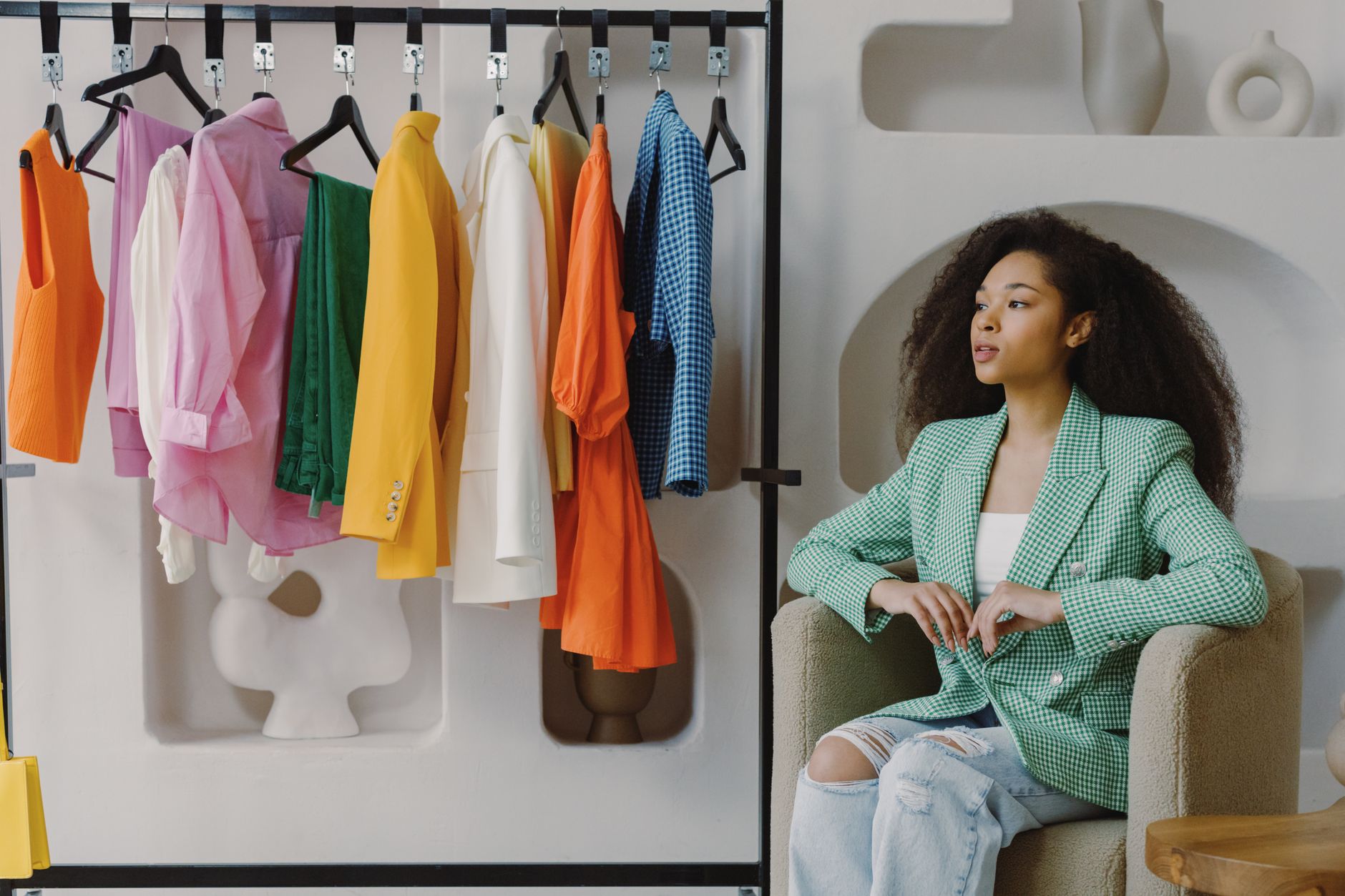
A $60 blazer worn forty times costs $1.50 every time you put it on. A $228 blazer worn 144 times costs $1.58. By the standard cost per wear formula, the cheap one wins, and that math is why half the internet has spent a decade telling you to stop buying “investment pieces.” The math is also incomplete. It assumes that when you’re finished with a garment, it is worth exactly zero dollars. In 2026, that assumption is the single most expensive thing in your closet.
The cost per wear formula treats your closet like it’s worth nothing
Price divided by wears. That’s the whole equation, and every version of it circulating online stops there. It’s a fine tool for talking yourself out of a bridesmaid dress. It’s a terrible tool for deciding between two coats, because it quietly classifies clothing as a consumable, like paper towels, rather than as an asset with a secondary market.
That was a defensible simplification in 2016. It isn’t now. ThredUp’s 14th annual Resale Report, released April 2, 2026 and modeled by GlobalData from a survey of 3,268 U.S. adults, projects the U.S. secondhand apparel market at $78.8 billion by 2030 and puts the global figure at $393 billion, roughly 10% of total apparel spend. In 2025, U.S. resale grew nearly four times faster than the broader retail clothing market. The resale value of your wardrobe stopped being theoretical somewhere around the time the market crossed ten percent of what everyone spends on clothes.
So the formula needs a second number: net cost per wear, which is price minus what you recover, divided by wears. Two variables instead of one. The second one changes the answer more often than the first.
Clothing got more expensive this year, and the sticker price is only half the story
The Bureau of Labor Statistics reported that the apparel index rose 3.9% for the 12 months ending June 2026, against 3.5% for all items. Clothing is outrunning general inflation, which it almost never does. The Budget Lab at Yale put the U.S. average effective tariff rate at 11.0% as of April 2, 2026, the highest since 1943, and identified clothing as one of the consumer categories absorbing the largest price effects.
Here’s the part that gets missed. Tariffs raise the price of new clothes, not used ones. Every dollar added to the retail tag flows into the resale market as a slightly higher floor for what a used version of that same garment fetches. Rising input costs make the cheap top more expensive without making it more durable, and they make the secondhand version of the good coat more valuable. The gap between “cheap to buy” and “cheap to own” is widening, and the standard formula can’t see it.
Resale liquidity is the variable nobody puts in the equation
Not every $228 garment has a resale market. Quality and liquidity are not the same thing, and the second one is what pays you back.
ThredUp’s 2026 report ranks the most-shopped resale brands by volume, and the list is not a luxury lineup: J.Crew first, then Zara, Ann Taylor LOFT, Old Navy, Gap, Madewell, Banana Republic, Athleta, Lululemon, and Ann Taylor. These are the brands with buyers waiting. Recovery rates track that demand. Resellers report Lululemon leggings moving at 60% to 80% of original retail, and contemporary labels like Madewell, Free People, and Reformation landing in the 30% to 50% range. A beautifully made jacket from a brand nobody searches for recovers approximately nothing, no matter how good the seams are.
Liquidity, not price and not even quality, is the deciding variable. Which means the question to ask in the fitting room is not “will this last?” It’s “when I’m done with this, will anyone be looking for it?”
The $228 blazer versus the $60 one, worked out in full
J.Crew lists the Parke blazer from $198 to $289 depending on fabric. Take the $228 version. Wear it twice a week from September through May, about 36 weeks, and that’s 72 wears a year. Two seasons gets you to 144. Straight cost per wear: $228 divided by 144, or $1.58.
Now sell it. A two-season Parke in good condition lists on Poshmark around 35% of retail, roughly $80. Poshmark takes 20% on sales above $15, leaving $64 in your account. Net cost is $228 minus $64, or $164. Divide by 144 wears and you’re at $1.14 per wear.
The $60 fast-fashion blazer runs the other direction. It looks correct for about a season before the shoulders go soft and the fabric pills, so call it 40 honest wears. That’s $1.50 per wear, and there is no resale line because a $60 blazer with pilling does not sell. To cover the same two seasons you buy it twice: $120 for 80 wears, still $1.50, still nothing to recover. Over 144 wears of blazer-wearing life, the J.Crew costs you $164 and the cheap route costs you about $216.
Run the same $228 through a brand with no resale demand and the math inverts. Nothing recovered means net cost stays $228, which is $1.58 per wear, and the fast-fashion blazer wins. Same price, same quality, opposite verdict. The resale market is doing all the work.
How to check for a resale market before you buy
All of which means the fitting-room decision now has a research step, and it takes about as long as reading the care label. Search the exact item on Poshmark or eBay and filter to sold listings, not active ones, because asking prices are fiction and sold prices are data. If ten comparable pieces sold in the last month at 30% or more of retail, the piece has liquidity and you can subtract that recovery from the sticker price before you decide. If you find three listings sitting untouched since spring, you’re buying a consumable and should judge it as one.
Two things skew the result. Silhouette-driven pieces hold value because a well-cut trouser reads the same in 2029 as it does now, while anything carrying a dated print or a logo treatment gets stranded the moment the trend turns. And condition dominates brand at resale: ThredUp resells at up to 90% off estimated retail on its own site, which tells you how fast a worn-looking version of the same garment gets discounted. The same authentication habits that matter when you’re buying secondhand luxury run in reverse when you’re selling, because the pieces easiest to verify are the pieces that move.
What this changes about your fall shopping list
August is when the fall wardrobe temptation peaks, and it is the right month to run this test, because the pieces you buy now are the ones you’ll wear through May. Applied properly, the corrected cost per wear formula does not tell you to spend more. It tells you to spend differently. It shifts money toward liquid categories from brands with real secondhand demand, and away from the $60 pieces that feel harmless individually and quietly cost more per wear than the thing you talked yourself out of.
It also means your closet is holding money. Nearly 50% of secondhand shoppers now discover items through social feeds rather than search, per ThredUp’s 2026 data, which is why things sell faster than they did three years ago. Pull five pieces you haven’t worn since last fall, check their sold comps, and list the ones with a market. That recovered cash is the second half of the formula, and it only counts if you actually collect it. Start there before you reorganize the closet around anything new.