

Take outdoor air at 20°F and 60% relative humidity, a completely ordinary November night in Denver or Chicago, and warm it to 70°F inside your house. You haven’t added or removed a drop of water. The relative humidity still drops to about 9%. I ran that number twice because I didn’t believe it. That 9% is what your skin, your eyes and the inside of your nose wake up to once the furnace runs for the season, and it’s why the best humidity for home in winter deserves an actual answer.
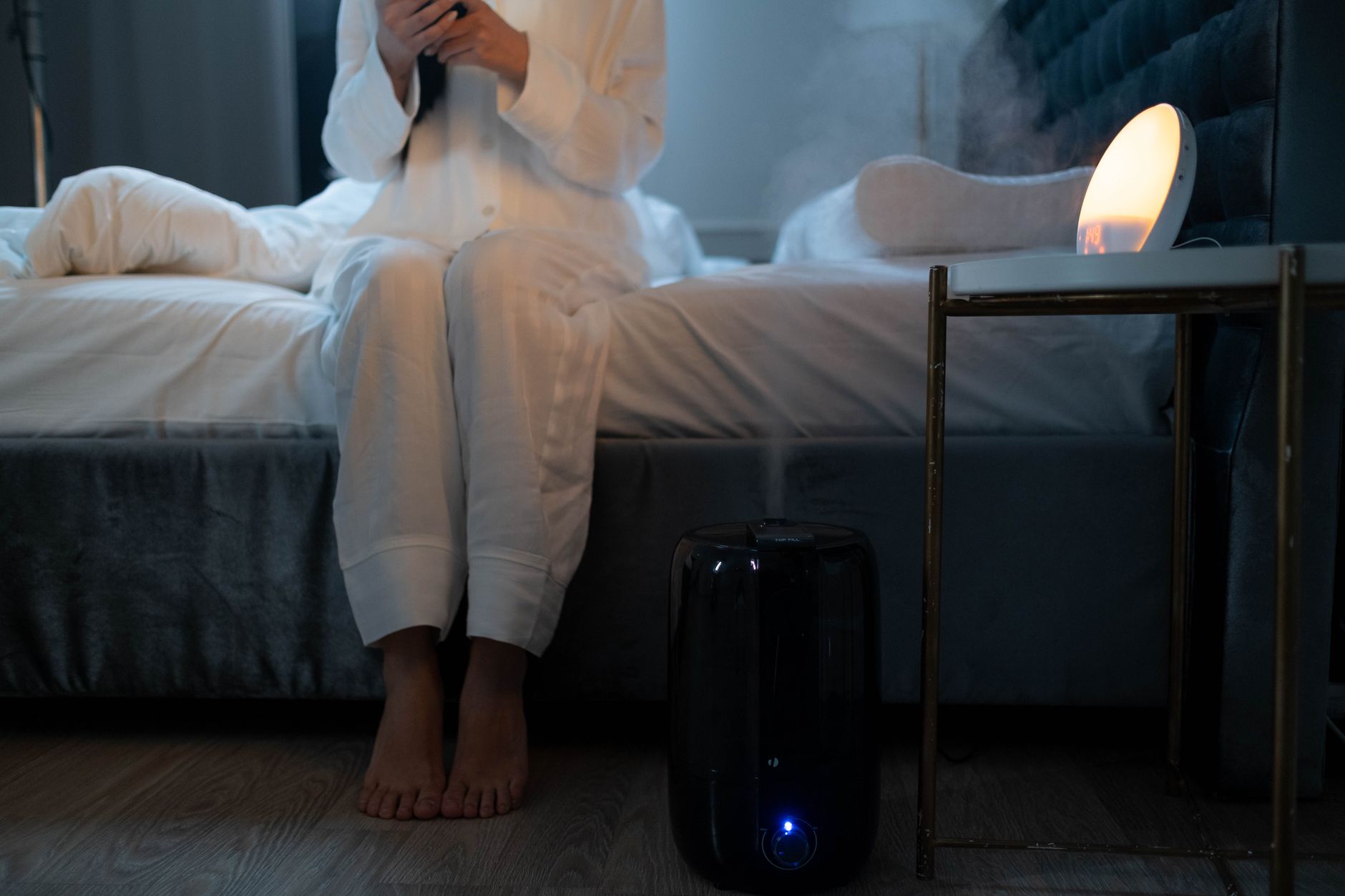
The answer most people land on is a $40 to $80 ultrasonic humidifier on the nightstand, filled from the bathroom tap. My argument is that this is the wrong tool for most homes. Fill it the way the EPA says to and the water costs more than the machine every winter. Fill it from the tap and it sprays your tap water’s minerals into the air as fine particles. An evaporative unit, set to a number your windows can handle, beats it on both counts.
Dry winter air really does wear down your skin barrier, but more moisture isn’t automatically better
The skin part isn’t wellness folklore. A 2016 review in the Journal of the European Academy of Dermatology and Venereology, by Engebretsen and colleagues, pulled together the research on climate and skin and concluded that low humidity and low temperatures lead to a general decrease in skin barrier function. Weaker barrier skin handles friction worse and reacts more to irritants and allergens. Cold, dry weather was also tied to more flares in people with atopic dermatitis. If your shins start itching around Thanksgiving and your moisturizer has stopped keeping up, this is a big part of the reason (we covered the routine side in our winter skin care steps).
The trap is overcorrecting. The EPA’s humidifier guidance, revised in June 2022, says not to run a humidifier above 50% indoor relative humidity, because higher levels encourage mold and dust mites. The Mayo Clinic says the same thing in plainer words: humidifiers can make you sick if they aren’t maintained or if humidity stays too high. So you’re aiming for a band, and in winter that band has a hard ceiling.
The best humidity for home in winter is set by your coldest window
Most humidity advice gives you one range, usually 30% to 50%, and stops there. The ceiling moves with the weather outside, because the coldest surface in your home decides where water condenses. That’s usually window glass.
The classic numbers come from N.B. Hutcheon’s “Humidity in Canadian Buildings,” published by the National Research Council of Canada in 1960 and still the table builders cite. With double windows and a 70°F room, condensation starts at about 53% indoor humidity when it’s 20°F outside on a windy day. At 0°F that maximum falls to 41%. At minus 20°F it’s 32%. The University of Minnesota Extension, writing for a state that sees those temperatures every January, says roughly 25% in winter is comfortable for people and better for the house, and it lists winter window condensation as a sign of too much moisture.
In practice: a $10 digital hygrometer in the bedroom, aim for the low 40s on mild nights, and drop the setting on cold snaps. Water beading on the inside of the glass in the morning means you’re past your house’s limit, whatever the box says.
An ultrasonic humidifier filled from the tap is a mineral sprayer
I get the appeal of ultrasonic units: they’re nearly silent and they look nice on a nightstand. They work by shaking water into a fine mist, and everything dissolved in that water goes into the air with it. The EPA says it directly: ultrasonic and impeller humidifiers are “very efficient” at dispersing minerals from tap water, and the white dust on your dresser is those minerals settling out.
What you can’t see is the stuff that doesn’t settle. In a 2021 study in Indoor Air, chemists at the University of Alberta led by Ran Zhao measured what a single ultrasonic humidifier put into a house. With tap water, PM2.5 reached up to hundreds of micrograms per cubic meter, and particles released in an upstairs bedroom spread through the whole home. The particulate mass tracked the water’s alkalinity, which points to calcium carbonate, and the team also found a surprising amount of sulfate. Store-bought distilled water produced no measurable particulate in their tests. The Alberta team’s concern is that particles this small slip past the filtering in your nose and throat and travel deep into the respiratory tract.
So the fix seems easy: buy distilled water. The EPA agrees, calling distillation the most effective way to cut minerals and warning that “spring” and “mineral” bottled water haven’t been demineralized at all. This is where the cheap humidifier gets expensive.
Running an ultrasonic humidifier the EPA way costs more than the humidifier
The Levoit Classic 300S is a good example because it’s one of the most popular smart ultrasonic models and Levoit publishes its specs. It costs $79.99 on Levoit’s site, holds 6 liters, and runs “up to 60 hours” on low.
Six liters over 60 hours is 0.1 liters an hour. Run it all day and that’s 2.4 liters, or about 0.63 gallons. Heating season from November 1 through March 31 is 151 days, so you’d go through roughly 96 gallons, and that’s on the lowest setting. Walmart’s Great Value distilled water is $1.54 a gallon right now. Ninety-six jugs comes to about $147 a season, nearly twice what the humidifier cost, and every one of those jugs has to be carried home and recycled. Your first winter comes to around $227.
Compare that with a machine that never needed distilled water in the first place. Honeywell’s HCM-350 pushes room air through a wet wick, so the minerals stay in the wick instead of floating around your room. It holds 1.1 gallons, runs up to 24 hours, and the black version is listed at $76.42 at Walmart. A compatible replacement wick costs $14.99. Even if you replaced the wick every month from November through March, which is a cautious assumption, the season costs $76.42 plus $74.95 in wicks, or $151.37 total. Its water comes from the tap, about 1.1 gallons a day, so it’s practically free. The EPA notes that evaporative and steam humidifiers generally release little or no minerals or microorganisms into the air.
That’s a $76 difference in the first winter. From the second winter on, it’s roughly $75 in wicks against $147 in water, every year. And unlike most “save money” advice, the cheaper option is also the one that keeps calcium carbonate out of your lungs.
Any humidifier is only as clean as you make it
Evaporative isn’t automatically clean. Any humidifier holding standing water can grow microbes, and the EPA is specific about upkeep for portable units: empty the tank, wipe it dry and refill it daily, and scrub it every third day. Where the manufacturer doesn’t say what to use, it suggests a 3% hydrogen peroxide solution followed by a thorough rinse. Mineral scale matters too, because the EPA notes that scale can be a breeding ground for microorganisms. That’s one more reason hard tap water and humidifiers get along badly.
If you have asthma or allergies, the Mayo Clinic suggests checking with your doctor before you add a humidifier, since both too-wet air and a dirty tank can make symptoms worse.
The two-minute version
The best humidity for home in winter is the highest number your coldest window tolerates without fogging, usually somewhere between the high 20s and low 40s, and always under 50%. Get there with an evaporative humidifier and plain tap water, check it with a hygrometer, and lower the target when the forecast drops below freezing. If you already own an ultrasonic unit you love, keep it, but budget for distilled water and count it as part of the price, because tap water isn’t a free version of the same thing. And with clocks falling back on November 1 and the heat about to run all evening, this weekend is a good time to set it up. If your house runs cold enough that you’re also eyeing a space heater, run the electric blanket math first.