

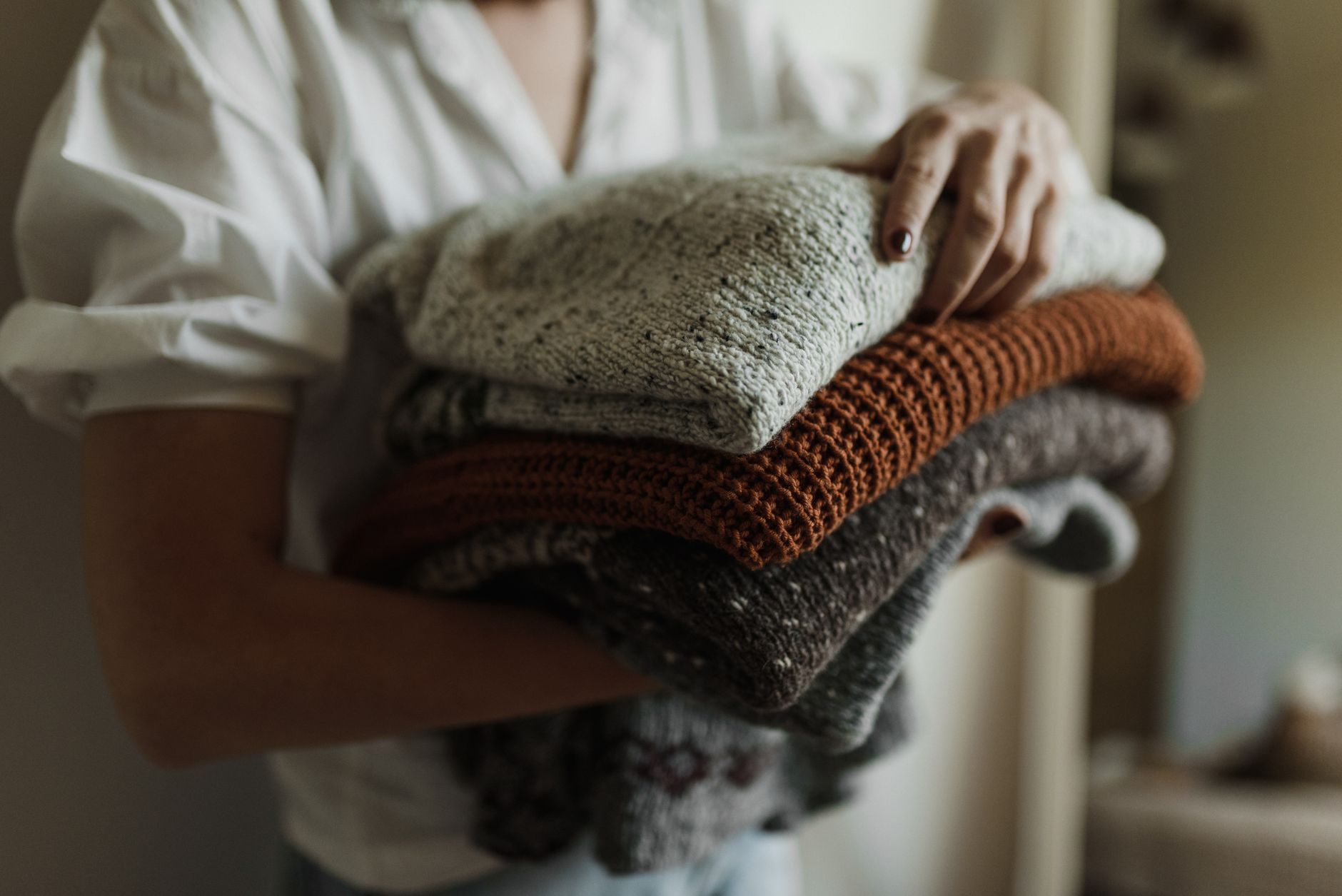
The tag inside your favorite gray cashmere crewneck is not a safety warning. It’s a legal minimum. Under the Federal Trade Commission’s Care Labeling Rule, a brand whose sweater can be washed or dry cleaned only has to print one of those instructions, and plenty of them pick the one that’s least likely to come back on them. So when you’re standing at the sink wondering whether you can wash dry clean only clothes, the more useful question is which word is printed on the tag. “Dry Clean” and “Dry Clean Only” mean different things, and the difference is worth about $175 every winter.
The FTC lets a “Dry Clean” tag skip the washing option entirely
The FTC’s compliance guide for manufacturers, “Clothes Captioning”, is blunt about this. “If an item can be washed and drycleaned, the label needs only one of these instructions.” A brand doesn’t have to tell you that hand washing works. It just has to give you one method it has a “reasonable basis” for, and dry cleaning is the method that’s hardest to blame when something goes wrong. If a sweater shrinks at a dry cleaner, the customer fights with the cleaner. If it felts in your sink, the customer emails the brand.
“Dry Clean Only” is the stronger claim. The same guide says it “warns that the garment can’t be washed,” and a manufacturer can’t use it unless it has evidence that washing would cause harm. That’s the tag to respect. A plain “Dry Clean,” with no “Only,” tells you dry cleaning is safe. It tells you nothing about water.
None of this shows up in the top-ranking guides on washing dry clean clothes at home. They give good fabric-by-fabric advice, but they treat every dry clean tag as the same cautious suggestion. It isn’t. One extra word turns “here’s a method” into a warning the brand had to back with evidence, so that word is the first thing to check.
Dry cleaning prices rose 5.3% in a year, so the tag now costs more
Bureau of Labor Statistics data, published through the St. Louis Fed’s FRED database, puts the consumer price index for laundry and dry cleaning services at 255.882 in September 2026, up from 242.915 in September 2025. That’s a 5.3% jump in twelve months and 10.5% over two years, faster than prices overall. Whatever you paid to have a sweater cleaned last winter, you’ll pay more this one.
Current price lists show what that means per item. I Hate Ironing, a pickup service covering New York, New Jersey, and South Florida, charges $13.60 to dry clean a sweater, $15.20 for cashmere, $7.70 for a blouse, and $23.75 for a coat. Neighborhood shops in other markets can be cheaper (Tide Cleaners’ Boston price guide listed sweaters at $6.94 to $8.75 back in 2020, before that 10.5% run-up), but whatever your local number is, you pay it every time a sweater starts to smell like your commute.
How to hand wash a wool sweater for about 15 cents
Wool and cashmere are the fibers most likely to carry a cautious dry clean tag, and they’re also among the easiest to wash by hand once you know what ruins them. What shrinks wool is heat and rough handling. Scrubbing, wringing, and hot water are the problem, not water itself, so a gentle soak at lukewarm temperature removes most of the risk.
The Woolmark Company’s method takes about 15 minutes of work. Fill a basin with lukewarm water, add a wool-specific detergent, soak the sweater for 10 minutes, rinse in lukewarm water and then cold, and dry it flat in the shade. Don’t wring it. Roll it in a towel and press the water out, then reshape it on a dry towel. A mesh drying rack is nice to have, but you don’t need one.
The detergent is the only real cost. A 16.9-ounce bottle of Eucalan No-Rinse Delicate Wash is $14.50 at Lion Brand, which says it covers about 95 hand washes. That’s 15.3 cents per sweater, and because Eucalan is a no-rinse formula, you can skip the two rinses if you’d like.
Now the winter math, using the New York prices above. Say you own two cashmere sweaters and one merino, and each gets cleaned four times between November and March. Dry cleaning the cashmere comes to 2 × 4 × $15.20 = $121.60. The merino adds 4 × $13.60 = $54.40. That’s $176.00 for the season. Washing all 12 at home costs 12 × $0.153, or $1.83. You keep $174.17, and that’s before the next price increase.
To get your own number, take your cleaner’s sweater price, multiply it by how many times a winter each sweater actually goes out, and add it up. If it comes out over $100, that’s a new sweater you’re paying for every year without getting one.
The pieces that should still go to a professional
The savings come from washing the right things at home. Your coat should still go to a cleaner. A tailored wool coat or blazer has interfacing, shoulder padding, and a lining, and those layers shrink at different rates in water, which is how you end up with a puckered lapel that can’t be pressed out. That $23.75 for a coat is a good deal next to replacing one. The same goes for anything structured: suits, pleated skirts, and dresses with built-in boning.
Rayon and viscose are the other big exception. Laundry testers at Reviewed say those fibers usually don’t survive washing well, and they’re the fabrics most likely to carry a “Dry Clean Only” tag that means it. Silk can usually be washed, but dyes on prints and saturated colors can bleed, so test first: dab an inside seam with a damp cotton swab and stop if any color comes off. Leave anything beaded, sequined, leather, suede, or vintage with the professionals.
A good rule: if a piece has one layer and is made of animal fiber or cotton, it can go in the sink. If it has a lining, a structure, or a fiber that turns weak when wet, let your cleaner earn the fee.
Washing at home also means less perc
There’s one more reason to cut down on trips to the cleaner, and it has nothing to do with your budget. Many conventional dry cleaners still use perchloroethylene, or perc, a solvent the EPA counts among its cancer-causing chemicals. In December 2024 the agency finalized a rule that would ban perc in dry cleaning within 10 years. In 2025 it reopened that rule for reconsideration, and in 2026 it proposed pushing back several worker-protection deadlines. The phaseout is moving slowly, and your cleaner may still be using perc. If you care about that, ask about wet cleaning or CO2 cleaning before you hand over the clothes that truly need a professional.
So, can you wash dry clean only clothes?
Sometimes, and the tag tells you when. Can you wash dry clean only clothes that are really labeled “Dry Clean Only”? Usually not without some risk, because the brand had to have evidence before printing that. But a sweater labeled plain “Dry Clean” in wool, cashmere, or cotton is almost always a 15-cent job in your bathroom sink. Check for the “Only” before anything goes to the cleaner this weekend, and send out just the coats and structured pieces.
If you’re buying more knitwear this season, our guide to telling good cashmere from the kind that pills covers what the tag doesn’t. And if your coat is the piece that does go to the cleaner, it’s worth checking whether it’s warm enough with our breakdown of down jacket fill power versus fill weight.