

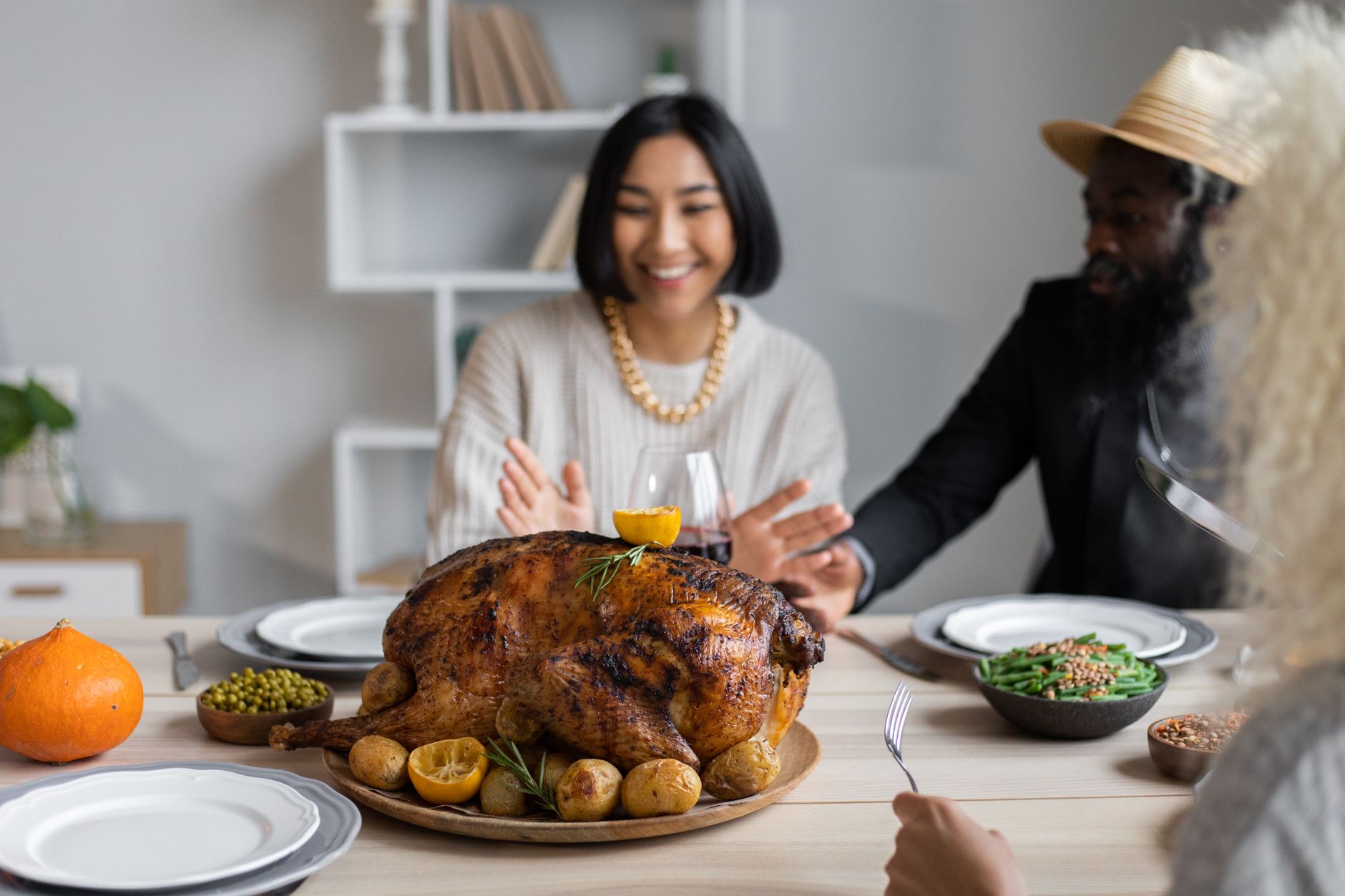
Roast chicken breast has more tryptophan than roast turkey breast. Not a little more, either: 362 milligrams per 100 grams versus 287, according to the USDA’s own nutrient database. Nobody has ever needed a nap after a Tuesday chicken sandwich, which tells you most of what you need to know about the most durable myth of the Thanksgiving table. So does turkey make you sleepy? No. Something on that table does, though, and the place it matters is the driver’s seat at 7 p.m., not the couch at 4.
Does turkey make you sleepy? It’s the least sleepy thing on your plate
The tryptophan story has a real chemistry lesson at its core, which is why it refuses to die. Tryptophan is an amino acid your brain uses to make serotonin and, eventually, melatonin. The problem is the dose and the competition. I pulled the numbers from USDA FoodData Central so you don’t have to: roasted whole turkey meat (light and dark together) carries 310 milligrams of tryptophan per 100 grams, roasted turkey breast 287, roasted chicken breast 362, and sharp cheddar 321. Turkey sits in the middle of an ordinary pack of protein foods. It isn’t some outlier.
Do the arithmetic on a generous serving. Six ounces of roasted turkey is about 170 grams, and 170 times 3.10 milligrams works out to 527 milligrams of tryptophan. The same weight of roast chicken breast gives you 615. And tryptophan from a protein-heavy meal has to fight every other amino acid in that meal for the same transporter into the brain, so piling on more protein doesn’t help it win.
Every explainer on this lands in the same place: blame the carbs, the portion size and the wine. They’re right about that. Then nearly all of them wrap up with a tip about taking a walk or loosening your belt, as if the worst outcome of a food coma is missing the second half of the Cowboys game. I think that’s where they stop too early, because most people who eat this meal get into a car afterward.
A 922-calorie lunch was enough to make drivers drift
The study that should be quoted every November isn’t a tryptophan study. It’s a driving study. In 2012, sleep researchers at Loughborough University published a trial in Physiology & Behavior that put 12 drivers in a full-size car simulator for a two-hour, monotonous afternoon drive (Reyner et al., 2012). On one day they ate a light 305-calorie lunch. On another they ate a heavy 922-calorie lunch with three times the fat and twice the carbohydrate. After the heavy lunch, sleepiness-related lane drifting rose significantly, and so did the brain-wave activity that tracks drowsiness. The gap between the two lunches showed up after the first 30 minutes on the road.
The study has limits. The drivers were young men who had slept only five hours the night before, and a simulator isn’t a highway. Still, a short night followed by a big afternoon meal and a long, boring drive describes Thanksgiving for a lot of us, especially if you were up at 6 basting.
Now put 922 calories in Thanksgiving terms, using USDA’s figures. Six ounces of roasted turkey is about 270 calories (159 per 100 grams). A cup of mashed potatoes made with whole milk and butter, roughly 210 grams, adds about 237 more at 113 per 100 grams. A 4-ounce slice of commercially made pumpkin pie, 113 grams at 243 per 100 grams, adds about 275. That’s 782 calories before stuffing, gravy, rolls, cranberry sauce, or a second slice of anything. Most of us clear the “heavy lunch” from that study well before dessert is cleared.
The wine is still working after you feel fine
The second half of the Loughborough story is the one that should change how you plan the evening. In an earlier trial in Human Psychopharmacology, the same group gave 20 sleep-restricted drivers either nothing or three units of alcohol, finished more than 90 minutes before a two-hour afternoon drive (Barrett, Horne and Reyner, 2004). By the time they started driving, their breath alcohol was near zero. Their driving was still worse, at least for the first hour, and the drivers didn’t feel any sleepier than on the sober day. The authors’ conclusion was blunt: breath alcohol levels are a poor guide to driver impairment.
Three British units sounds abstract, so here’s the conversion. A UK unit is 8 grams of pure alcohol, so three units is 24 grams. A US standard drink, which is a 5-ounce pour of 12% wine, contains 14 grams. Divide 24 by 14 and you get about 1.7 drinks. In other words, less than two modest glasses of wine, finished an hour and a half before you get in the car, was enough to measurably worsen sleepy driving in that study. If you pour like most of us do at holiday tables, I wrote about that wine pour math here, and those two glasses are really closer to three.
Drowsy driving is badly undercounted, and Thanksgiving is a driving holiday
Outside the lab, the numbers are big. AAA’s 2025 Thanksgiving forecast counted 81.8 million people traveling 50 miles or more, and at least 73 million of them, nearly 90%, went by car. If you’ve weighed the drive against a flight, you probably drove (here’s that cost math), and that means the meal and the commute land on the same day.
Federal crash records listed 633 deaths in drowsy driving crashes in 2023. The Governors Highway Safety Association’s 2026 update argues the real number is about ten times higher (GHSA, 2026). It applies an AAA Foundation estimate that 17.6% of fatal crashes involve a drowsy driver, which works out to about 6,326 deaths in 2023. Police can’t breathalyze tiredness, so it gets recorded as something else or not at all. The same report says roughly one in five drivers admits driving drowsy at least once in the past month.
How to eat the whole meal and still get home safe
You can keep the stuffing. What changes is the order of decisions: settle the drive before anyone fills a plate. If I had two hours on the highway after dinner, this is how I’d run the day.
Eat early if you can choose. A 1 p.m. dinner and a 6 p.m. departure gives your body five hours, while a 4 p.m. dinner and a 6 p.m. departure puts the drive right in the window where the heavy-lunch drivers started drifting. If the host’s timing is fixed, choose who drives before anyone pours. The designated driver isn’t only for people who plan to get drunk. Given what the 2004 study found, the person behind the wheel is better off skipping wine altogether than trusting a “two drinks, then wait” rule.
Split the plate instead of shrinking the holiday. The heavy lunch in that trial was a single 922-calorie sitting. Pie at 7 p.m., after the drive, is the same pie.
Take the first yawn seriously. The GHSA report lists frequent yawning, long blinks, and drifting as the warning signs, and it notes that breaks and caffeine help only for a limited time. That means a coffee buys you a stretch of road, not the whole trip. If the drive is longer than an hour or two, the honest options are to switch drivers, stop somewhere safe to rest, or stay over and leave Friday morning.
Turkey was never the culprit. My issue with the myth is that it turns drowsiness into a cute holiday side effect, when the research describes a driving impairment you can see coming as soon as you know the menu, the dinner time and who has the car keys. Does turkey make you sleepy? Your plate size, your wine glass, and your short night do. Plan your drive home around them, and eat the second slice when you get there.