

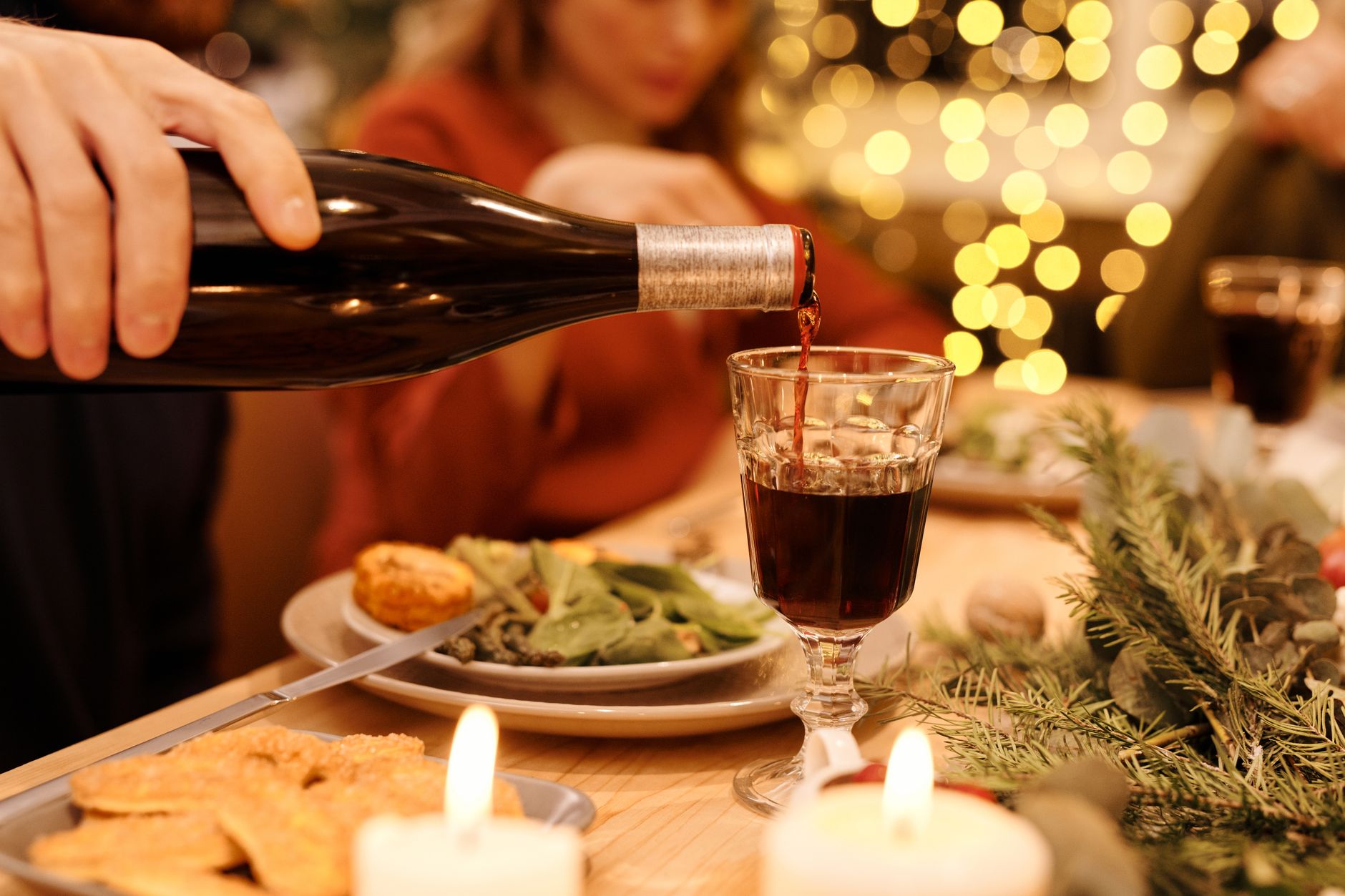
Every guide to how much wine for Thanksgiving gives you the same answer: one bottle for every two guests. Ten people, five bottles, done. That math assumes a bottle pours five glasses. In my dining room it pours closer to three, and the guide never asked what glasses I own. If your cabinet holds the big-bowled stemware most of us have bought in the last 20 years, the half-bottle rule runs dry somewhere between the turkey and the pie.
Your family isn’t the variable here. The ounce is, and once you measure it you can solve the shortage two ways: buy more wine, or pour less into each glass. One of those costs $38 more. The other costs nothing.
The “five glasses per bottle” rule is a bar standard, not a home one
The five-glass bottle comes from the standard drink. The National Institute on Alcohol Abuse and Alcoholism defines one U.S. standard drink as 0.6 fluid ounces of pure alcohol, which for table wine is 5 ounces at about 12% alcohol. A 750 ml bottle holds 25.4 ounces, so you get five drinks with a little left over. Party calculators and sommeliers build their bottle counts on that number.
Almost nobody pours 5 ounces, even professionals. When researchers from the Alcohol Research Group bought and measured drinks at 80 bars and restaurants across 10 Northern California counties in 2007, the average wine pour came in at more than 6 ounces, about 43% larger than a standard drink. Their findings ran in Alcoholism: Clinical and Experimental Research in 2008. If people paid to measure liquid overpour by that much, the person topping off Aunt Carol’s glass between bites of stuffing is not going to do better.
Your glasses got bigger, so your “glass” of wine did too
The second culprit is sitting in your cabinet. A University of Cambridge team led by Theresa Marteau measured 411 wine glasses dating from 1700 to the present, and in The BMJ’s 2017 Christmas issue they reported that average capacity rose from 66 ml in the 1700s to 449 ml in 2016 and 2017. That’s nearly seven times larger, and most of the growth came after the 1990s. A 449 ml glass holds about 15 ounces. Pour a true standard drink into it and the glass looks a third full, which to most hosts reads as stingy.
So we fill it until it looks right. Shape and color change how much “looks right” means. In a study published in Substance Use and Misuse, Doug Walker and Laura Smarandescu of Iowa State and Brian Wansink of Cornell found that people poured about 12% more wine into wide glasses than into standard ones, and 9% more when pouring white wine into clear glass, where the low contrast makes the level hard to judge. Holding the glass while pouring added more still. Thanksgiving checks every one of those boxes: wide red-wine bowls, a pale Chardonnay for the turkey people, and someone pouring with the glass in hand while they talk.
How much wine for Thanksgiving, with the math shown
Here’s the same table run three ways. Ten adults, and the standard guide’s assumption that each drinks two and a half glasses over a long afternoon and dinner, for 25 pours in total.
At the 5-ounce standard, 25 pours is 125 ounces. Divide by 25.4 ounces per bottle and you need 4.93 bottles, so five. That’s the half-bottle rule, and it only works at a bar-standard pour.
At the 43% larger pour the California researchers measured, each glass is about 7.15 ounces. Twenty-five of those is 178.75 ounces, or 7.04 bottles. Add the 12% that wide glasses tack on and each pour reaches about 8 ounces. Now 25 pours is 200 ounces, which is 7.9 bottles. You need eight, and each bottle gives you just over three glasses.
Price it with something you’d actually find on a holiday table. Josh Cellars Cabernet Sauvignon is $12.57 at Walmart right now (rolled back from $13.97). Five bottles cost $62.85. Eight cost $100.56. The gap is $37.71 for one dinner, with not a single extra guest and no one drinking more glasses than the guide predicted. The only difference is ounces.
If you’re pouring imports, that gap grows. European wine has carried a 15% U.S. tariff since August 2025, and the U.S.-EU trade pact that took effect July 1, 2026 keeps that rate in place through 2029. Vinetur reported in April that average U.S. retail prices for European wines had risen about 7% over the year. This year’s Beaujolais Nouveau, which releases Thursday, Nov. 19, one week before Thanksgiving, is the first to arrive with the 15% rate locked in by treaty, and every overpour of a French bottle pays that premium on wine nobody planned to drink.
Measure the pour once and five bottles go back to being enough
Buying eight bottles answers the shopping question. I don’t think it’s the right answer, because the extra wine isn’t something your guests asked for. It’s a side effect of the glassware.
Look at what those 8-ounce pours do. Josh Cabernet is 13.5% alcohol, stronger than the 12% the standard drink assumes. An 8-ounce glass of it holds 1.08 ounces of alcohol, which is 1.8 standard drinks. So a guest who thinks she had “two and a half glasses” had about 4.5 standard drinks. For context, NIAAA uses four drinks in about two hours as the typical pattern for binge drinking in women, and a sit-down dinner with a long cocktail hour gets close to that timeline. Nobody at your table has to feel like they overdid it to have done exactly that.
The fix takes about 30 seconds. Before guests arrive, pour 5 ounces of water from a measuring cup into one of your glasses and look at where the line sits. That’s your pour. If you have narrower white-wine glasses or stemless tumblers, use them; the Iowa State work suggests a narrower glass alone trims the pour. Set the bottle on the table instead of pouring from your hand, and let whoever’s serving pour with the glass resting on the table.
At a 5-ounce pour, the Josh math looks like this: 5 ounces at 13.5% is 1.125 standard drinks, 25 pours is 125 ounces, and five bottles cover it with almost half a glass to spare. I’d still buy a sixth for $12.57 as a buffer, because one guest always brings a plus-one. Six bottles at $75.42 still beats eight at $100.56 by $25.14.
The bottle count is a pouring decision
The half-bottle rule is fine. It just leaves out the one variable that changes the answer by 60%, and that variable is the glass, not the guest list. Decide your pour first, then count bottles. A 5-ounce pour and the standard rule line up. An eyeballed pour into a 15-ounce bowl means about three glasses per bottle, so plan for eight bottles for ten people, or plan to swap the glasses.
Once you’ve settled how much wine for Thanksgiving, that $25 has better uses than a seventh and eighth bottle nobody asked for. Our math on homemade vs store-bought pie says a butter crust costs $1.18, so the difference between six and eight bottles buys a lot of pie. And whatever wine you open, the 2-hour clock for leftovers starts when the turkey leaves the oven, not when the last glass is poured.