

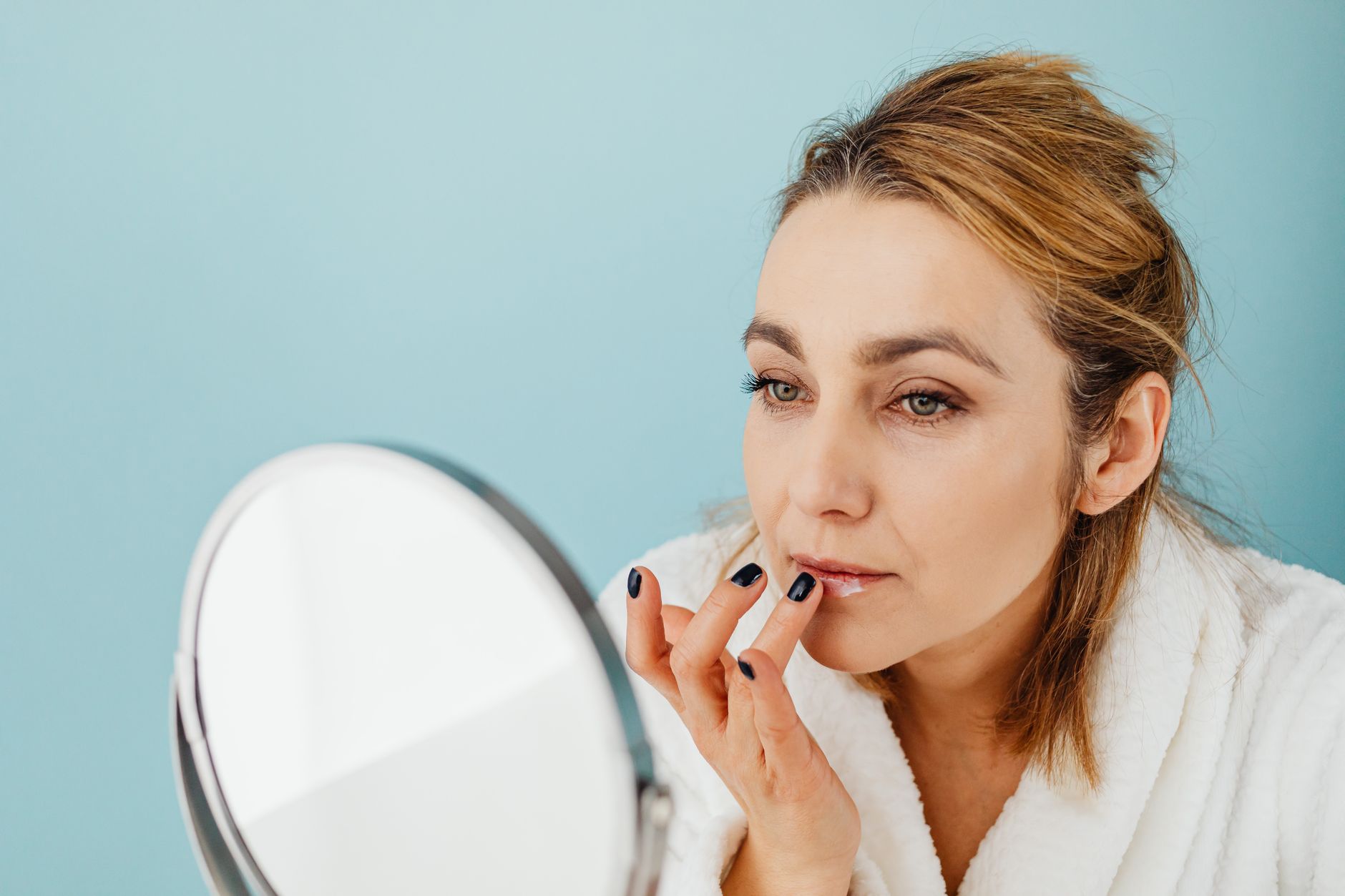
Pull the tube of Carmex out of your coat pocket and read the back. Camphor, menthol, phenol, salicylic acid, lanolin, flavor. Now pull up the American Academy of Dermatology’s list of things to avoid when your lips are chapped. Every one of those six is on it. If you’re shopping for the best lip balm for chapped lips this week, as the heat clicks on and your lips start to peel, the answer is boring and cheap: plain petroleum jelly, which costs $2.49 for a 1.75-ounce jar at Target. Everything else you add to it is mostly a chance to make things worse.
Your lip balm can be the reason your lips stay chapped
Lips are a strange patch of skin. They have almost no oil glands and a thin outer barrier, so they lose water faster than your cheeks do. When the furnace runs and indoor humidity sinks into the teens (we did the winter humidity math here), that loss speeds up. The fix is an occlusive, a layer that sits on top and slows evaporation. Petrolatum is the best-studied one there is.
The trouble is what brands put alongside it. The AAD’s guidance on healing dry, chapped lips tells you to skip camphor, eucalyptus, menthol, lanolin, fragrance, phenol, propyl gallate, salicylic acid, octinoxate and oxybenzone, plus flavorings like cinnamon, citrus, mint and peppermint. Its rule of thumb is blunt: if a product burns, stings or tingles, it is irritating your lips, so stop using it. That tingle so many of us read as “it’s working” is your skin complaining.
That sets up the loop people call lip balm addiction. You apply, the occlusive part soothes for an hour, the irritant part inflames the skin a little more, the lips feel tight again, and you reach for the tube. Dermatologists will tell you lips can’t become dependent on balm. They can get stuck in a cycle of mild irritation that you keep restarting yourself, though.
The tubes dermatologists name still carry ingredients on the avoid list
Most articles on chapped lips stop at the general warning. They list the bad ingredients, then point you to the same few drugstore names. The more useful exercise is to hold the bestsellers up against that list, ingredient by ingredient.
Carmex Classic is the obvious one. The full ingredient list for Carmex Classic pairs 45.3% white petrolatum and 1.7% camphor with lanolin, beeswax, menthol, salicylic acid, phenol, vanillin and flavor. That is a good occlusive base carrying six ingredients the AAD tells chapped lips to avoid.
Aquaphor Healing Ointment surprised me more, because it’s the jar people swear by and the one you’ll see recommended in nearly every chapped-lip roundup. It’s 41% petrolatum with mineral oil, ceresin, panthenol, glycerin and bisabolol, which is a lovely formula, except that it also contains lanolin alcohol. Lanolin was named the 2023 Allergen of the Year by the American Contact Dermatitis Society, and the paper making that case in Cutis reports that 3.3% of patients patch-tested by the North American Contact Dermatitis Group from 2001 to 2018 reacted to it. For most people Aquaphor is fine. If yours keep peeling while you use it faithfully, though, it’s a suspect, not a cure.
The luxury tier has the opposite problem: the ingredient list gets longer as the price goes up. Laneige’s Lip Sleeping Mask, a $24 cult favorite that NBC Select called an editor favorite in June 2026, lists fragrance, two synthetic dyes and coconut oil among its 34 ingredients. It feels wonderful. It is also a fragrance-containing product on lips the AAD says should be fragrance free while they heal.
Women are the ones getting patch-tested for this
There’s a reason this matters more to you than to the guy in the next cubicle. When the North American Contact Dermatitis Group pulled the records of 196 patients whose rash showed up only on the lips (from 10,061 people tested between 2001 and 2004), 84.2% of them were women. A full 38.3% turned out to have allergic contact cheilitis, meaning an allergy to something touching their lips. The most common culprits were fragrance mix, Myroxylon pereirae (balsam of Peru, a fragrance and flavor ingredient) and nickel, according to the study published in Dermatitis in 2008.
Read those numbers together. More than a third of people with stubborn lip rashes were reacting to an ingredient, and the top offenders are the scents and flavors that make a balm pleasant to use. Lipstick, flavored balm, toothpaste and the metal rim of a water bottle all reach the same small strip of skin. The study doesn’t say why the patients skewed so heavily female, but it isn’t hard to guess that the person with three lip products in her bag has more chances to meet the one she’s allergic to.
The best lip balm for chapped lips costs 24 times less than the cult favorite
Here is the math, using prices current this week. The Laneige mask is $24 for 20 grams, which works out to $1.20 per gram. A 1.75-ounce jar of Vaseline is about 49.6 grams for $2.49 at Target, or roughly 5 cents per gram. Buy the same 20 grams of occlusive from each and you pay $24.00 for the Laneige versus about $1.00 for the Vaseline ($2.49 multiplied by 20, divided by 49.6). That’s a 24-fold markup for fragrance, color and texture.
Stretch it across a winter. Say you go through one Laneige jar by the end of January and a second by spring. That’s $48. One jar of Vaseline on your nightstand and a second in your bag runs $4.98, and you’ll probably finish neither. The $43 you didn’t spend would buy a mineral sunscreen lip balm for daytime, which is the one thing plain petrolatum can’t do.
That last point matters. The AAD wants an SPF 30 or higher lip balm outdoors even in winter, reapplied every two hours, and it suggests zinc oxide or titanium dioxide over chemical filters like oxybenzone and octinoxate, both of which sit on its avoid list. Snow reflects UV, and lips have very little melanin to protect them.
A two-product routine gives chapped lips room to heal
Keep it to two products. At night, put a thick layer of plain petroleum jelly on your lips right before bed, thick enough that you can see it. If you sleep with your mouth open or run the heat high, this is the step that does most of the work. During the day, use a fragrance-free mineral SPF balm when you’re outside and plain petrolatum when you’re not.
Then fix the habits that undo it. Stop licking your lips, because saliva evaporates and takes moisture with it. Stop peeling flakes. Put away the sugar scrub until your lips have healed, since exfoliating a broken barrier is one more irritant on top of the others. If you want to see how other skincare ingredients fight each other in the same way, our piece on skincare ingredients that cancel each other out uses the same logic for your face.
Give it two or three days. If your lips aren’t improving, or you notice swelling, itching or cracking at the corners, that pattern can point to an allergy or another skin condition, and it’s worth a visit to a board-certified dermatologist who can patch-test you. Don’t keep switching balms and hoping.
The best lip balm for chapped lips this winter isn’t the one with the prettiest jar or the most satisfying tingle. It’s the one with the shortest ingredient list. Keep the Laneige for a night when your lips are healthy and you want a treat. While they’re cracked, use the $2.49 jar.