
Last October, in a single joint sweep at the Cincinnati mail facility, U.S. Customs and Border Protection and the FDA pulled 398 shipments holding 8,521 pairs of contact lenses that were headed to doorsteps across the country. Most were never going to correct anyone’s vision. They were going to turn someone’s eyes white, red, or cat-slit for one night. That is the part of Halloween makeup safety that the usual advice buries under “patch test your face paint,” and it is the part that can cost you an eye infection instead of a bad photo.
My case is simple. Your cheeks, forehead, and jawline can take almost anything a reputable costume aisle sells. The danger sits in roughly an inch around each eye, where two things show up every October: contact lenses bought like accessories, and neon or glow pigments that federal rules specifically keep away from the eye. Get that zone right and the rest of your look is a matter of taste.
The $20 Halloween contacts are illegal for a reason, not a technicality
Since a 2005 federal law (Public Law 109-96), every contact lens sold in the U.S. counts as a medical device, including purely decorative ones with zero vision correction. The FDA’s page on colored and decorative contact lenses is blunt about it: sellers offering them without a prescription “for as little as $20” are breaking the law, and that covers beauty supply stores, salons, boutiques, Halloween shops, and websites that never ask for your eye doctor’s information.
The reason is fit. A lens is not one-size-fits-all. An eye doctor measures the curve of each eye and watches how your cornea handles a lens before writing a prescription that names a brand, a size, and an expiration date. A lens that is too tight or too loose can scratch the cornea, and a scratch on a wet surface sealed under plastic is how infections start. The FDA warns that bacterial infections from poorly fitted lenses can take hold “sometimes within as little as 24 hours.” You could put them in for a Saturday party and be in urgent care by Sunday afternoon.
Cosmetic lenses carry about 16 times the infection risk of regular contacts
A 2019 review in the journal Eye by Lim, Stapleton, and Mehta, summarizing a French case-control study, put the infection risk for cosmetic contact lens wearers at roughly 16.5 times that of people wearing ordinary corrective lenses. In 12 French university hospitals, cosmetic lens wearers made up 12.5% of corneal infection cases, which is a lot for a product most people wear a few nights a year. The same review flags buying online as an independent risk factor, and names Pseudomonas aeruginosa, a fast-moving bacterium, as the most common culprit in cosmetic lens cases.
The FDA points to the other half of the problem: sellers who skip the prescription also tend to skip the instructions, handing over lenses with little or no guidance on cleaning, storage, or which solution to use, and the wrong solution is its own infection route. That lands hardest on first-timers, which is why the agency’s Halloween guidance says October 31 should not be the first night you ever wear contacts. A costume that requires your first-ever lens has two problems, and only one of them is the lens.
Doing Halloween contacts the legal way costs more than your whole Halloween
I priced out the legitimate route, because “see an eye doctor” is easy advice to give and harder to budget for. According to Lens.com’s September 2026 price survey, a contact lens exam plus fitting at Walmart, Costco, or Sam’s Club runs about $70 to $170 without insurance, and $95 to $150 at chains like Target Optical, LensCrafters, and Pearle Vision. A two-lens box of Air Optix Colors (one month of wear for both eyes) is $49.95 at EZContacts. Eyeconic lists the same lens with a zero-power option, which is what you want if you see fine already.
So the math goes like this. A $70 warehouse-store exam plus a $49.95 box comes to $119.95. At the top of the warehouse range, $170 plus $49.95 is $219.95. Compare that to the $20 street pair and the legal version costs you an extra $99.95 to $199.95. For context, the National Retail Federation’s 2026 Halloween survey (7,889 consumers, fielded in early September) expects the average person to spend $115.14 on Halloween in total, candy and decorations included. Doing contacts properly costs more than the entire average Halloween.
Now run the other side. CDC researchers estimated in MMWR that keratitis and contact lens disorders drove about 988,000 doctor and ER visits in one year, at $174.9 million in direct costs. Divide one by the other and that’s roughly $177 per visit, and that is only the average visit, before follow-ups or what an infected cornea does to your week. Where I land: if you already wear contacts and have a current prescription, ask your eye doctor about a colored version and enjoy it. If you don’t, spend the $20 on a better eyeliner and skip the lenses entirely. Witches (4.8 million of them this year, per NRF) and vampires (4.2 million) have been pulling off unsettling eyes with makeup for a century.
Neon and glow-in-the-dark makeup belong on your cheeks, never your lids
This is the gap I don’t see covered in the safety roundups, and it matters most for anyone heading to a blacklight party. The FDA’s novelty makeup guidance says there are eight fluorescent colors approved for cosmetics (D&C Orange No. 5, 10, and 11; D&C Red No. 21, 22, 27, and 28; and D&C Yellow No. 7), and “none of them are allowed for use near the eyes.” Those neon pinks and oranges that pop under UV light are exactly what tutorials smear across the lid and into a graphic wing.
Glow-in-the-dark is stricter still. Luminescent zinc sulfide is the only luminescent color approved for cosmetics, and the regulation that governs it, 21 CFR 73.2995, caps it at 10% of a facial product’s weight and limits it to “limited, infrequent occasions, e.g., Halloween.” Products that contain it must carry the label “Do not use in the area of the eye.” That phrase is on the packaging. Most of us just never turn the tube over.
The practical fix takes 30 seconds in the store: flip the package and look for “not for use near the eyes” before you buy anything neon, UV-reactive, or glowing. If you want a glowing look, put it on your cheekbones, collarbones, or a stripe down the nose, and keep the eye itself in regular eyeshadow and liner from your everyday bag. And if your face is already busy with actives, check our guide to skincare pairings that cancel each other out before you layer a heavy paint over a fresh retinol night.
The face paint advice still applies, it’s just the easy part
Once the eye zone is handled, the rest of the safety checklist costs almost nothing, which is why it gets all the airtime. The FDA recommends testing a new product on your arm 24 to 48 hours before the event and watching for redness, swelling, or a rash. A paint that smells off may be contaminated. Face paints have been recalled before (the FDA cites recalls in 2005 and 2009 for rashes, itching, and swelling), so buy from a brand you can identify, and take everything off the way the label says before bed, gently around the eyes. The same goes for spirit gum on a fake beard or lashes: remove it with the product the label names, not by peeling.
Halloween makeup safety comes down to one inch around each eye
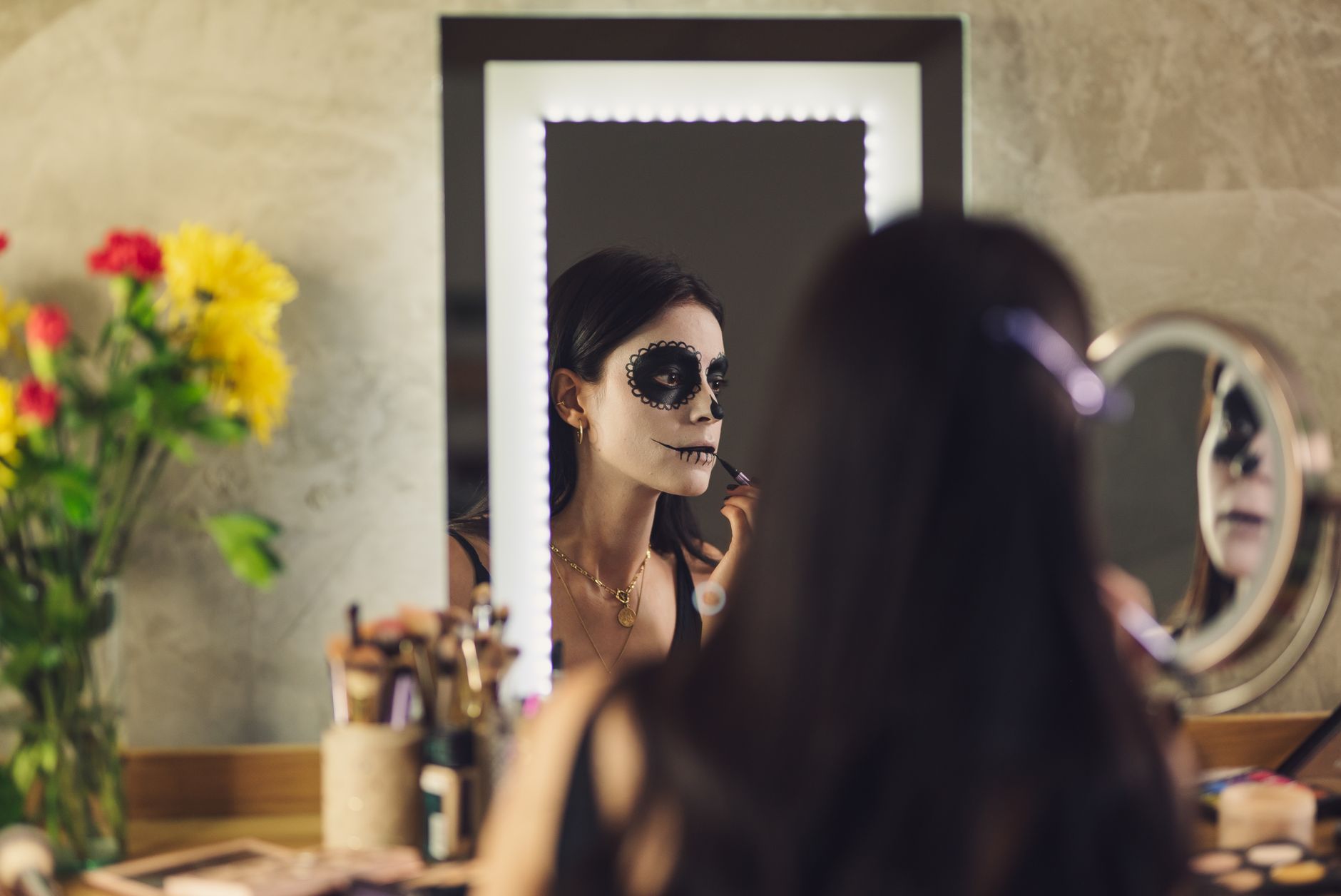
If you remember one thing about Halloween makeup safety this year, make it the inch around your eyes. Nothing goes on the eye that wasn’t prescribed for it, and nothing neon or glowing goes on the lid. Everything else (the green witch skin, the gray zombie contour, the fake blood dripping from a vampire’s lip) is fair game with a 48-hour patch test.
Then put the $20 you didn’t spend on street contacts toward the good stuff. Our math on Halloween candy prices says that buys roughly 230 fun-size chocolates in the November 1 clearance aisle.