

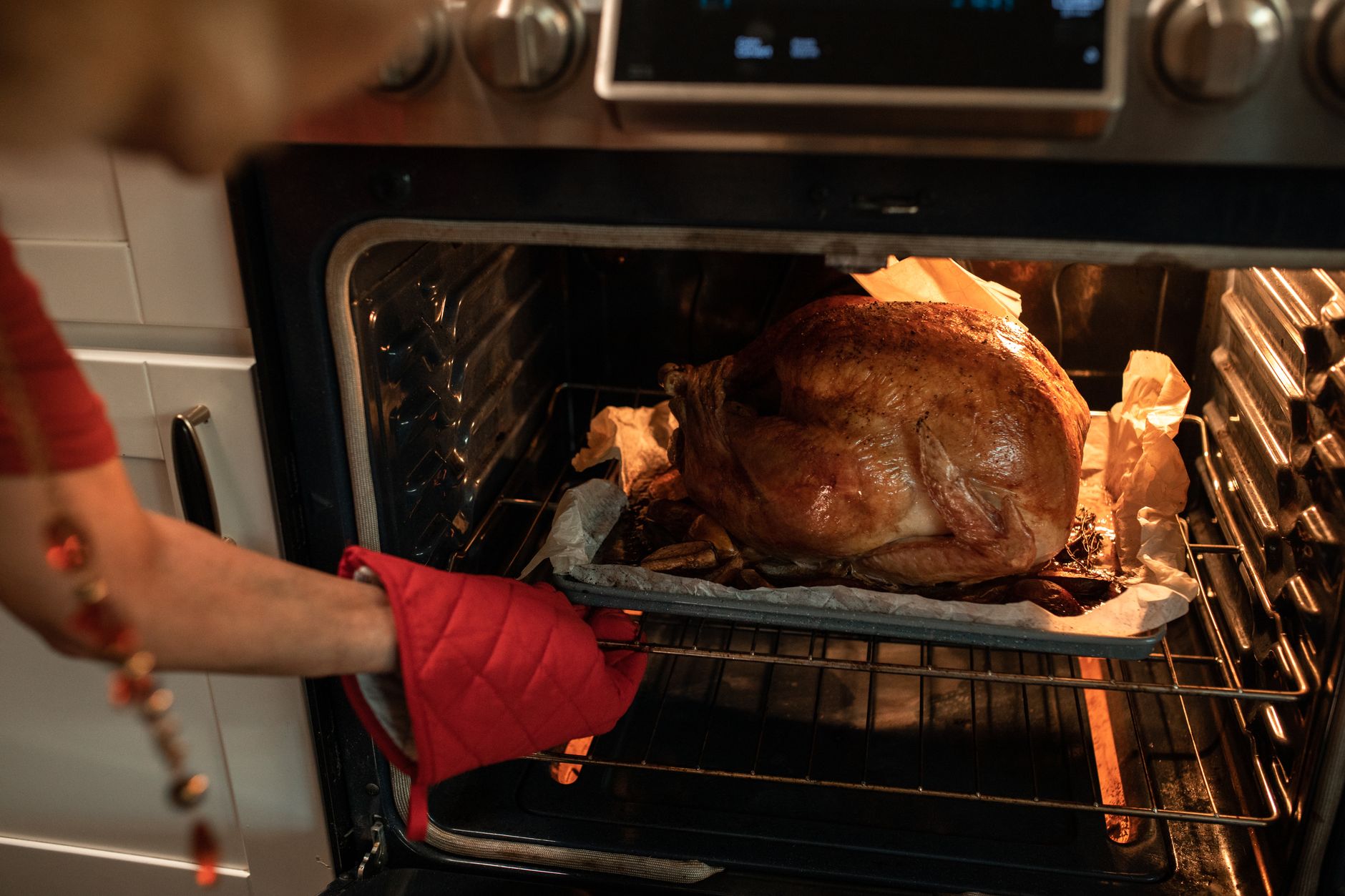
The most dangerous dish at Thanksgiving is the stockpot of stuffing that goes into the fridge at 9 p.m., lid on, still warm in the middle. Ask how long Thanksgiving leftovers are good and you’ll get the USDA’s answer, three to four days in the fridge, repeated by every local news site in America. That number is correct. It’s also the second rule. The first one decides whether day three is safe at all, and almost nobody follows it, because it requires you to leave the table before the pie comes out.
This matters more in late November than in any other month. The CDC says Clostridium perfringens causes nearly 900,000 foodborne illnesses in the United States every year, and that most outbreaks happen in November and December, many tied to turkey and roast beef. It’s the germ of big batches held at the wrong temperature. Which is a fair description of a holiday kitchen at 4 p.m.
The 2-hour rule starts when the turkey leaves the oven
The USDA’s guidance is to refrigerate leftovers within two hours. Most of us hear that as “two hours after dinner,” which in practice means somewhere after the dishes, the second glass of wine, and the football game. The two hours are about time spent in the danger zone, the 40°F to 140°F range where bacteria multiply fastest. A turkey that comes out of the oven at 1:30 and rests on the counter for 30 minutes has already spent part of its budget before anyone picks up a fork.
So here’s the timeline I’d actually put on the fridge. Bird out at 1:30, carved at 2:00, dinner from 2:15 to 3:15. The leftovers need to be in the fridge by 3:30, which is before dessert in most families. That’s the real trade. You give up 15 minutes at the table so the turkey sandwich on Sunday is a sandwich and not a gamble.
The CDC’s own case files show why the clock matters. A 2016 MMWR report traced an outbreak at a catered Thanksgiving lunch in Pitt County, North Carolina, where turkeys were cooked about 10 hours ahead and then held in warming pans or at room temperature for up to 8 hours with no temperature checks. Of the 58 attendees who answered the health department’s survey, 44 got sick (76%). People who ate the turkey or stuffing had an 86% illness rate, versus 43% for those who skipped them. Your kitchen is not a caterer’s van. The mechanism is the same, though: perfringens forms spores that survive cooking, and the trouble starts when cooked food lingers warm.
Why a deep pot of stuffing is the leftover to worry about
The two-hour rule assumes the food actually gets cold once it’s in the fridge. A deep container breaks that assumption. Restaurants are held to a two-stage standard that home cooks never hear about: cooked food has to drop from 135°F to 70°F within 2 hours, then from 70°F to 41°F within the next 4. The Washington State Department of Health, like most health departments, tells kitchens to hit that by spreading food in a layer no deeper than 2 inches, uncovered, in the fridge.
The USDA’s home version says the same thing more gently: use shallow containers, cut the turkey into smaller pieces, and store the stuffing separately from the bird. A lidded 6-quart Dutch oven of cornbread dressing parked on the middle shelf is the opposite of all three. The outside chills, the middle stays warm for hours, and the dish your aunt is proudest of becomes the riskiest thing in the fridge.
The 2-inch math for your actual pans
The 2-inch rule sounds fussy until you run it on the pans you already own. A standard 9 by 13 inch baking dish filled 2 inches deep holds 9 × 13 × 2, or 234 cubic inches. A U.S. quart is 57.75 cubic inches, so that pan holds about 4 quarts at the safe depth. A 6-quart pot of stuffing therefore needs one and a half 9 by 13 pans, or one 9 by 13 plus an 8 by 8 (128 cubic inches at 2 inches, about 2.2 quarts). Gravy is easier, since it’s liquid: split a big batch across two or three quart containers instead of one tall one.
For the turkey, get the meat off the bone before it goes in. A whole carcass in a roasting pan is a big, dense lump with a cavity that holds heat, and the USDA specifically says to cut it into smaller pieces. Five minutes with a knife at 3:15 saves you a debate on Saturday about whether the bird “smells fine.” Bacteria that cause food poisoning usually don’t change the smell or taste, so your nose isn’t a reliable test either way.
How long are Thanksgiving leftovers good? Until Monday, and Sunday decides
Once the food is cooled properly, the USDA’s three to four days applies. Thanksgiving 2026 falls on November 26. Count Thursday as day zero and day four lands on Monday, November 30. That makes Sunday the day to decide what’s getting eaten and what goes in the freezer. The USDA says frozen leftovers are safe indefinitely at 0°F and keep their best quality for 2 to 6 months, so a bag of turkey frozen on Sunday is a December pot pie. The same turkey pulled out Tuesday goes in the trash.
The trash is where a lot of it goes. ReFED estimated that Americans would waste 320 million pounds of food on Thanksgiving 2025, worth about $550 million, and that roughly 40% of what gets tossed is turkey. Its October 2025 host survey found that more than 90% of hosts deliberately cook extra, and 12% have no plan at all for the leftovers.
Put those numbers on your own table. ReFED’s figures work out to about $1.72 per pound of wasted food ($550 million divided by 320 million pounds). If you end the long weekend scraping 6 pounds of stuffing, sides, and turkey into the bin because nobody could remember when it was cooked, that’s about $10.31 gone. The American Farm Bureau’s 2025 survey put the classic dinner for ten at $55.18, so you’d be throwing away close to a fifth of the meal’s grocery bill. The bigger cost is the one ReFED doesn’t count: a family that loses confidence in its leftovers stops eating them on Saturday, which is when they’re still perfectly good.
The leftover plan I’d actually use this year
Set a phone alarm for two hours after the turkey leaves the oven. When it goes off, the person who didn’t cook portions the leftovers into shallow containers while everyone else finishes eating. Stuffing goes in 9 by 13 pans at 2 inches, gravy in quart containers, turkey off the bone into flat bags. Write “Thu” on masking tape on every lid. If guests are driving more than two hours home with a plate, the USDA says to keep it at 40°F or below in a cooler with ice or gel packs.
Then make one decision on Sunday: eat it by Monday or freeze it now. When you reheat, the USDA’s leftovers guidance says to bring food to 165°F on a thermometer and gravy to a rolling boil.
So how long are Thanksgiving leftovers good? Three to four days, yes, but only if you won the first two hours. If you’re still deciding on the bird itself, our breakdown of fresh vs frozen turkey covers the label that matters, and if the dates printed on everything else in your fridge confuse you, read what food expiration dates actually mean.