

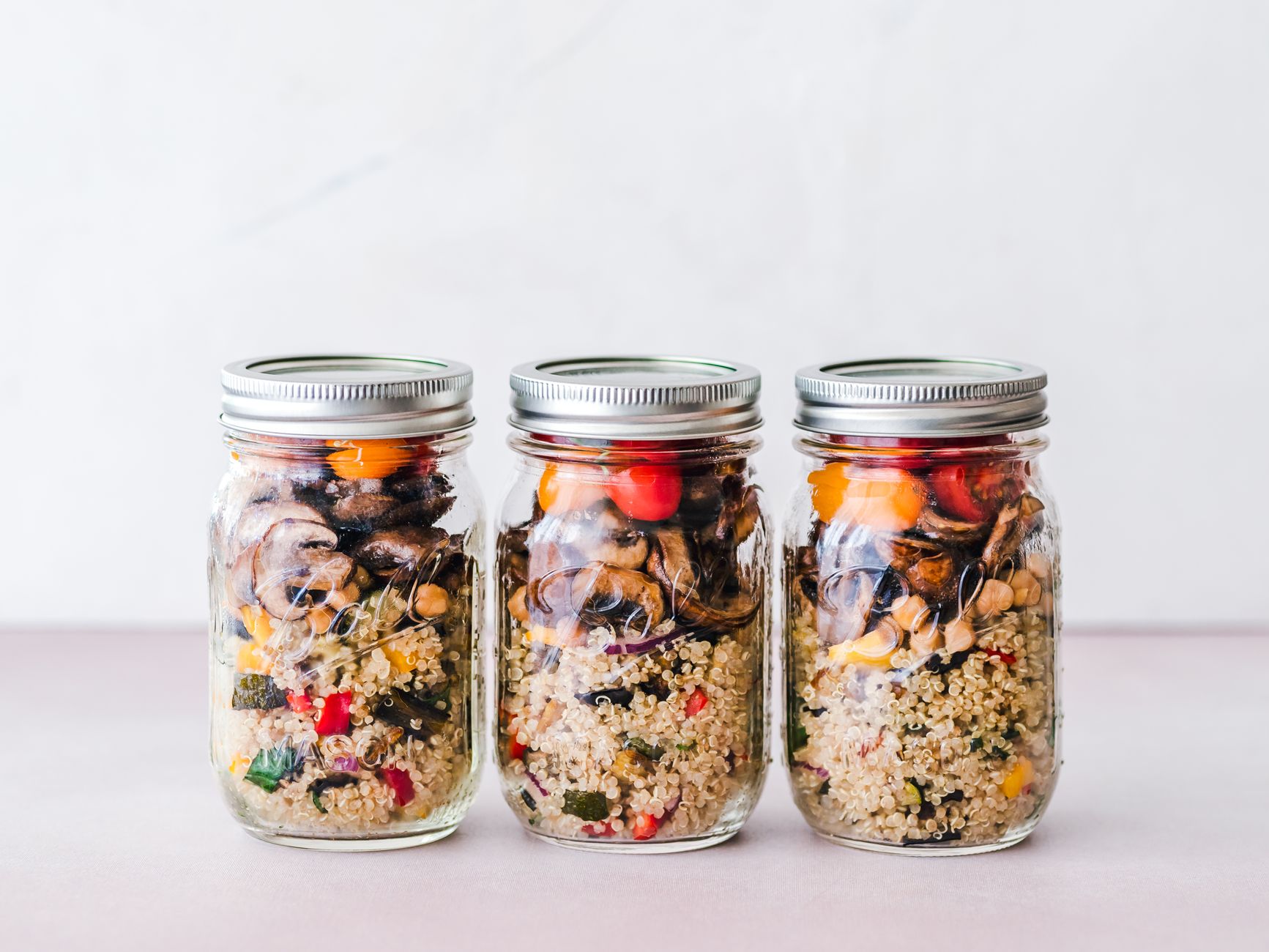
The reason your Sunday meal prep tastes like a hospital tray by Wednesday isn’t your cooking. It’s your architecture. You cooked five identical portions of chicken and broccoli to the same doneness, sealed them warm, and now you’re reheating them for the fourth time in a hot week when the last thing you want is a steaming plastic container of yesterday. Good summer meal prep solves this by refusing to build meals at all. It builds components, keeps them cold, and lets you assemble something that tastes made-that-morning in ninety seconds. The difference between grim and genuinely good is entirely structural.
Start with the food-safety facts, because they quietly dictate the whole strategy. The USDA’s Food Safety and Inspection Service is clear that cooked leftovers keep in the refrigerator for three to four days, not the seven you were optimistically planning for. That single number is why prepping the whole week on Sunday fails: by Thursday, day-five chicken is both a texture crime and a safety one. Food-safety guidance also recommends two shorter prep sessions a week over one marathon, which is the opposite of what every “Sunday reset” video tells you, and it’s the reason those videos end in Thursday takeout.
Prep components, not meals
Here’s the shift that changes everything. Store the pieces separately and each one performs to its own timeline. Cooked grains, roasted proteins, and sturdy vegetables hold their three-to-four-day window when they’re kept apart, while an assembled bowl is really only good for a day or two before the dressing turns the greens to slime and everything blurs into one sad texture. So you cook a pot of farro, roast a tray of vegetables, shred a rotisserie chicken, whisk a jar of dressing, and wash a head of greens. Five components, none of them a “meal,” all of them capable of becoming four or five different lunches depending on how you combine them. Monday is a grain bowl. Tuesday the same chicken goes into a wrap. Wednesday it tops a salad. Nothing repeats exactly, so nothing feels like a rerun.
The summer bonus is that this approach leans into no-reheat eating, which is exactly what you want when it’s 90 degrees and turning on the oven feels like a personal attack. Cold farro tossed with cucumber, cherry tomatoes, feta, and a lemon-olive-oil dressing isn’t a compromise. It’s a better lunch than the reheated one, and it never touches a microwave.
The safety rules that summer actually enforces
The heat raises the stakes, so it’s worth knowing where the real lines are. The general rule is that perishable food shouldn’t sit at room temperature longer than two hours, but FoodSafety.gov tightens that to one hour once it’s above 90 degrees, the kind of afternoon that describes most of August. That matters for the lunch riding in your bag to the office or the picnic cooler at the beach. An insulated bag with an ice pack isn’t fussy overkill; it’s the thing standing between your grain bowl and a bad evening. Keep the cold components cold until you eat, and the whole system stays boringly safe.
This is also why component prep beats batch-assembling for summer specifically. The fewer hours your food spends in the danger zone between fridge and plate, the better, and grabbing three cold containers to combine at your desk keeps everything colder longer than hauling one pre-dressed bowl that’s been slowly warming since 7 a.m.
The real math on why this beats takeout
Let me show you the arithmetic, because the case for prepping at all lives in the numbers. A desk salad or a fast-casual grain bowl runs about $14 in most cities now, closer to $16 or $17 once you add the delivery fee and tip. Do that five days a week and you’re spending roughly $70 to $85 on lunch alone. Now price the component version. A box of farro is about $3 and yields six servings. A rotisserie chicken is $6 or $7 and stretches across three or four lunches. A tray of vegetables to roast runs maybe $5, a block of feta $4, a bag of greens $3, and a jar of homemade dressing costs pennies from pantry oil and vinegar. Call it $22 to $24 for the week, generously. That’s under $5 a lunch against $14 to $17, so you’re saving somewhere north of $50 every single week, more than $200 a month, for about forty minutes of actual work spread across two evenings. The prep isn’t a chore you do instead of having a life. It’s a raise you give yourself in exchange for washing a cutting board twice.
Build a base, then chase flavor
The last thing standing between component prep and food you actually crave is seasoning, and this is where most healthy meal prep quietly gives up. Plain grains and plain protein are the problem, not the plan. Keep three finishing moves within reach and every combination tastes deliberate: something acidic (a good vinegar, a lemon, quick-pickled onions), something with crunch (toasted seeds, nuts, crushed pita), and something bold (a spoon of harissa, a crumble of feta, a drizzle of chili crisp). Those are the elements restaurants use to make a $16 bowl taste like $16, and they cost you almost nothing to keep on hand. A cold farro bowl with quick-pickled red onion and chili crisp is not sad desk food. It’s the lunch your coworker asks about.
Good summer meal prep, then, isn’t about willpower or a color-coded container system. It’s about building a small pantry of ready components, respecting the three-to-four-day fridge window, keeping everything genuinely cold in the heat, and finishing each bowl with acid, crunch, and something bold. Do that and the Wednesday slump never comes, because Wednesday’s lunch was never going to be a rerun in the first place.
Sources: USDA Food Safety and Inspection Service (leftovers and food safety), FoodSafety.gov (summer food safety, above 90 degrees rule)