

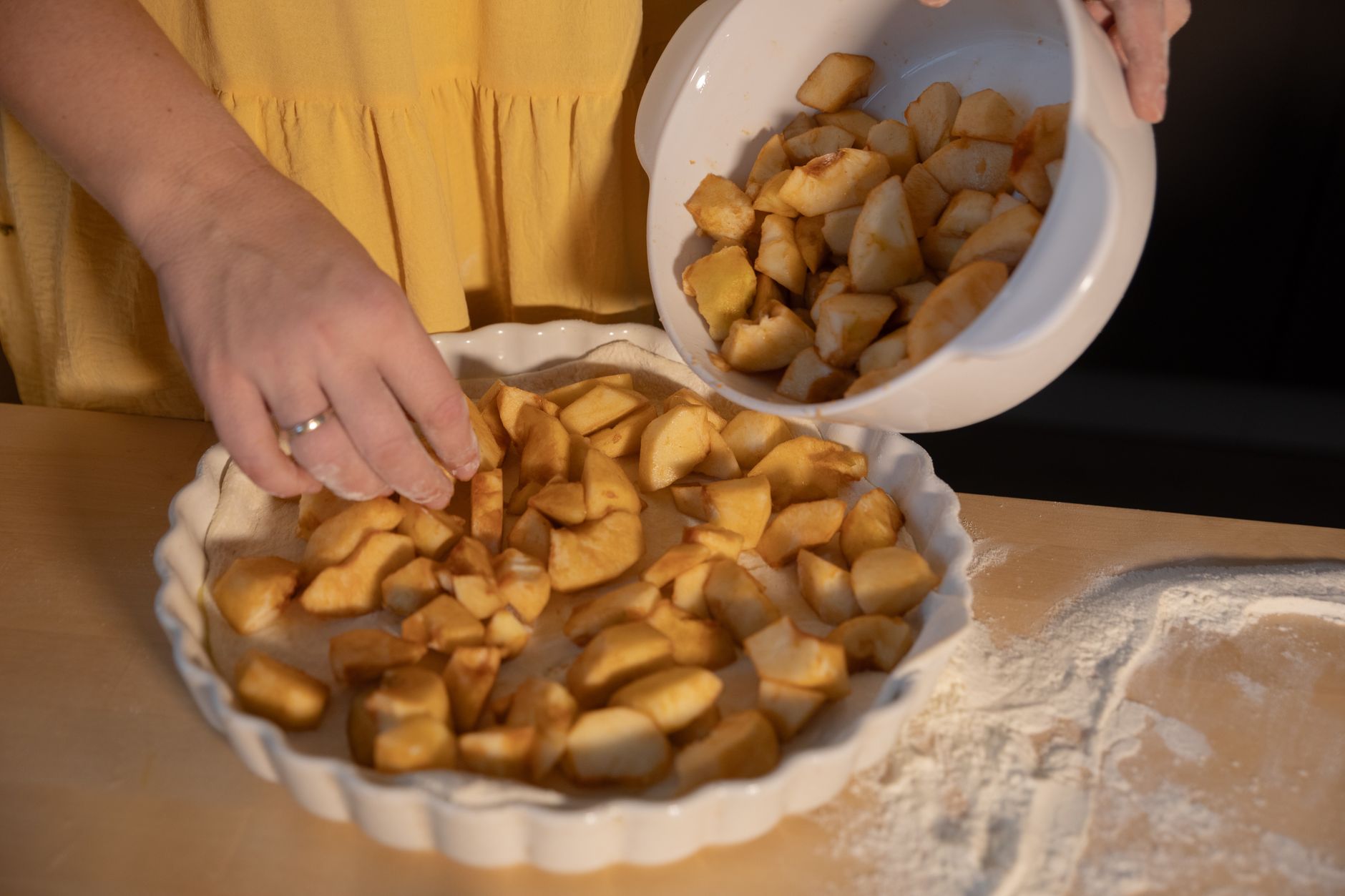
The USDA’s grocery ad report for the week ending October 2, 2026 put Honeycrisp at an average advertised price of $2.00 a pound and Granny Smith at $1.24. Buried in the same report is a more interesting line: baking apples like Jonathan and McIntosh are suddenly showing up in more store circulars. That tells you something every list of the best apples for baking skips. October is the one month when the soft, fragrant, slightly unfashionable apples are actually fresh, and they are the ones that make a pie taste like apples.
The standard advice is fine as far as it goes. Use Granny Smith for tartness, Honeycrisp for structure, and keep Gala and Red Delicious out of the oven. What it leaves out is the variable that decides whether your filling tastes bright or tastes like sweet, warm cardboard: how long the apple has been in storage, and what that storage was designed to protect. Spoiler: it protects crunch, and crunch costs you flavor.
Your “fresh” grocery apple may be from last year’s harvest
At USApple’s Outlook conference this August, the association’s analytics lead, Chris Gerlach, told growers that Cosmic Crisp was the most common variety in storage as of June 1, and that this inventory was meant to carry stores until roughly November or December, when new-crop sales begin. He called it “full on a 12-month variety or more,” as The Packer reported. So a Cosmic Crisp in your cart this week could easily be one picked in the fall of 2025.
Commercial packers hold apples in low-oxygen rooms and often treat them with 1-MCP, a compound that blocks ethylene, the gas that tells fruit to ripen and soften. It works. The apple comes out months later still snapping when you bite it. Nothing on the sticker tells you which harvest you’re buying, though, and (much like the dates printed on your groceries) the thing you can see is not the thing you care about.
This year’s crop adds a wrinkle. USDA’s first estimate has the 2026 national harvest down 7% from last season, and growers at the same conference said Pennsylvania may be down about 50% after a once-in-a-generation freeze, with New York down around 19%. More of that damaged fruit is headed for juice and processing. If you live in the Northeast or mid-Atlantic, your orchard’s best heirloom varieties may sell out faster than usual. Go early in the month, not the weekend before Thanksgiving.
Knowing your apple might be old is only half the problem, though. The other half is what the storage did to it.
Crunch and aroma trade off, and storage picks crunch
The case against the firmest apple in the bin comes from a 2025 study in Postharvest Biology and Technology. Researchers stored four modern varieties (Cosmic Crisp, Envy, Joya and RedPop) under three standard commercial methods: ultra-low oxygen, ultra-low oxygen plus 1-MCP, and dynamic controlled atmosphere. 1-MCP had the longest-lasting effect on firmness. When the team analyzed texture and aroma compounds together, the two moved in opposite directions. Their conclusion was blunt: continually pushing texture through postharvest technology will hurt the fruit’s aromatic profile.
The study looked at raw fruit, not pie, so what follows is my read rather than their finding. In a pie, sugar and cinnamon take care of sweetness. The part that makes it taste like apple pie and not cinnamon jam is the apple’s own aroma, and that is exactly what long storage and crunch-first breeding give up. A slice that comes out of a 425°F oven perfectly intact is doing the crust’s job, not the filling’s. It holds the shape and adds very little taste.
The best apples for baking come in pairs
King Arthur’s PJ Hamel ran a side-by-side years ago that still holds up better than most roundups. She baked six varieties with identical sugar, temperature and time. McIntosh collapsed into what she called “chunky applesauce.” Cortland was very soft, bordering on mushy, but had distinct apple flavor and a good balance of sweet and tang. Russets stayed very firm with a mild taste. Granny Smith landed in the middle: slices held their shape, with medium sweetness and a touch of tang. Her ideal pie used Cortland for flavor, a russet for texture, and Granny Smith for both.
That is the rule I’d steal. One apple holds the structure, one soft, fragrant apple carries the flavor, and the soft one partly melts into a sauce that glues the firm slices together. You don’t need four varieties or a farm-stand pilgrimage. A firm apple plus a McIntosh or Cortland gets you most of the way there, and October is when those soft varieties are freshly picked instead of pulled from a storage room.
Honeycrisp is the apple half the internet pushes for pie, and it does hold its shape. But at $2.00 a pound it’s among the priciest apples in this week’s USDA ad data (only Cosmic Crisp and Envy cost more), and Hamel didn’t even include it in her test. If you already have a bag on the counter, use it as the firm half. Just don’t pay a premium to make it the whole pie.
An orchard peck costs less than a bag of Honeycrisp
Here is the math using real prices. King Arthur’s apple pie recipe calls for about 3 1/4 pounds of whole apples for a 9-inch pie. At the USDA’s average advertised Honeycrisp price of $2.00 a pound, an all-Honeycrisp pie costs $6.50 in apples. Bake four for the holidays and you’ve spent $26.
Now split each pie half and half: 1.625 pounds of Granny Smith at $1.24 ($2.01) and 1.625 pounds of McIntosh at $1.47 ($2.39). That’s $4.40 per pie, or $17.62 for four. You save about $8.40 and get a filling with more going on.
The orchard version is cheaper than you’d expect. In the Boston.com 2026 orchard guide, Bartlett’s Orchard in Richmond, Massachusetts charges $17 for a pick-your-own peck. A peck runs roughly 10 to 12 pounds, which works out to about $1.42 to $1.70 a pound. Three pies take 9.75 pounds, so a single $17 peck covers them at around $5.67 per pie, with a few apples left for eating. That’s less than the all-Honeycrisp pie, and every apple in it came off the tree that week. Prices vary a lot by farm (Autumn Hills Orchard in Groton charges $3.50 a pound), so check before you drive out.
October is the only month this math works
By January the soft varieties are gone or have spent months in storage, and the grocery shelf is back to whatever kept best. That is when Hamel herself said she leans on Granny Smith alone, and it’s the right call then. The two-apple pie is a fall move.
So if you’re planning Thanksgiving or Friendsgiving baking (or booking the flight home to eat someone else’s), buy your apples this month. King Arthur’s recipe notes that the pie is better baked ahead, cooled completely and warmed by the slice, and that it freezes for longer storage. Pick up a firm apple and a soft, fragrant one, bake now, and freeze.
The best apples for baking are the ones that still smell like something when you cut them open. In October, that usually means the soft one sitting next to the Honeycrisp, and it’s probably the cheaper of the two.