

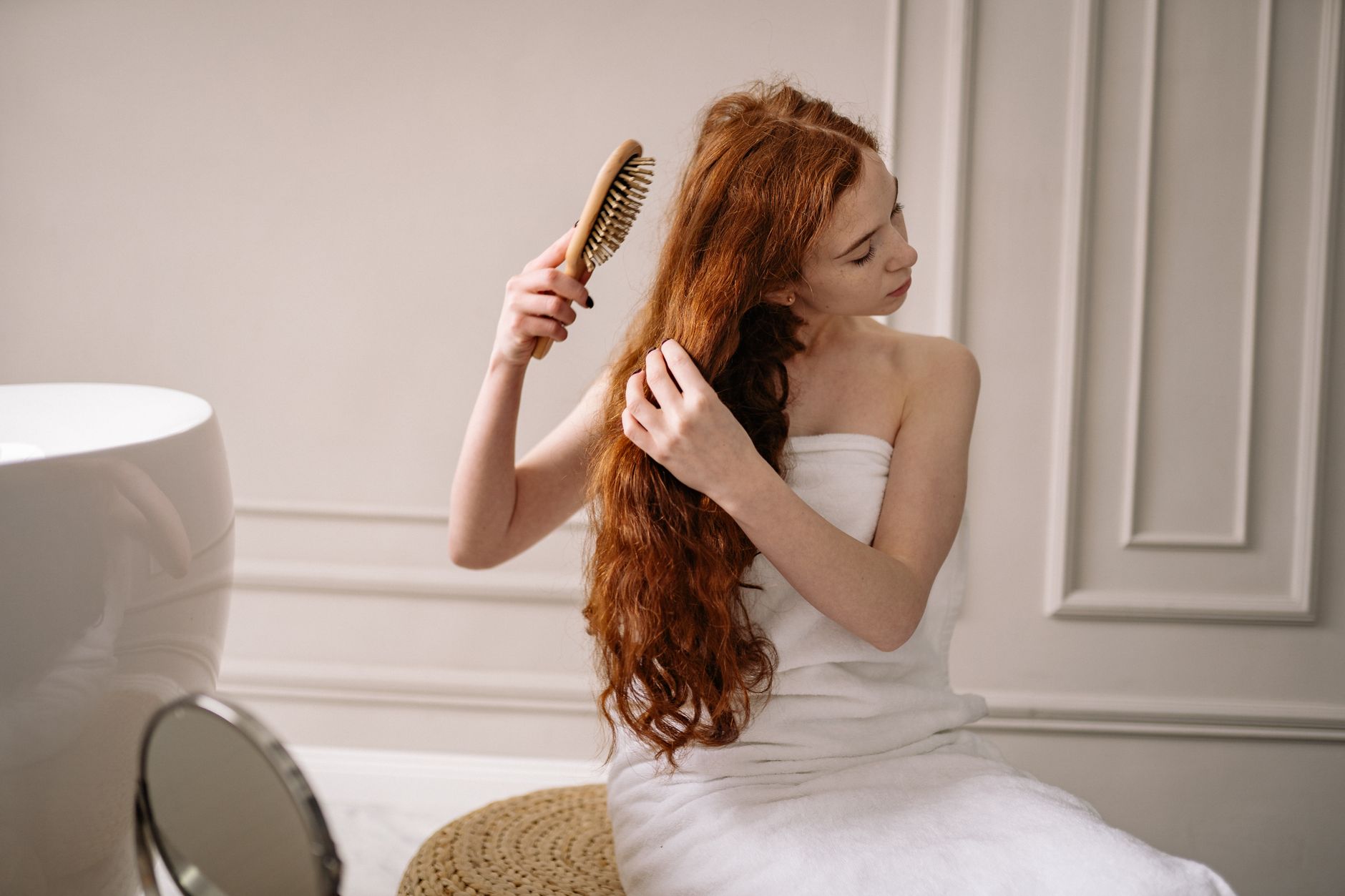
Only 14% of American beauty shoppers think a higher price signals a better product. That number comes from Circana’s mid-2025 beauty report, and in the same six months, prestige hair sales climbed 6% to $2.3 billion, with treatments driving the launches. So we don’t believe the price tag and we buy the $75 jar anyway. Especially in the third week of August, when the hair that went into June looking fine now feels like straw from the ears down. We spent the summer engineering makeup that survives a heat wave and let the hair fend for itself.
Summer hair damage repair has become a category built around one product type. Search the phrase and the first page belongs to Olaplex, Davines, and Kevin Murphy, all of whom sell a bond builder, and all of whom give you the same four steps: clarify, apply a bond treatment, follow with a mask, book a trim. Every step of that is defensible. It is also arranged in the order that moves the priciest item, and it skips the part where a dermatologist explains which half of the routine you are literally rinsing away.
Your August hair damage is oxidation, and it looks a lot like bleach
The reason your ends feel different in August rather than just drier is that sunlight does chemistry on hair, not weather. Research published in the International Journal of Cosmetic Science in May 2026 by Nathana Ramos and colleagues at Grupo Kosmoscience and the University of São Paulo put unbleached hair through controlled UV exposure and measured both the cuticle and the cortex. The oxidative protein damage they measured in the cortex was comparable to what bleaching does, in hair that had never been lightened.
The mechanism was mapped years earlier. Tryptophan is the one amino acid in keratin that absorbs strongly in the UVB range, and when it gets excited it hands that energy to the cystine bond next door, which snaps. What you get back is cysteic acid, a permanent oxidation product, plus a measurable drop in tryptophan content. A separate 2025 paper in the same journal by Plowman’s team pinned down where in the keratin structure heat and UV do the most damage. So the hair you are trying to rescue has not lost moisture. It has lost sulfur chemistry, and it happened while you were reading a paperback on a towel.
The bond products you rinse out are the ones doing the least
Given that, a bond builder sounds like exactly the right answer, and in principle it is. The trouble is which format you buy it in. In the August 2025 issue of Dermatology Times, Zoe Diana Draelos, MD, a clinical faculty member in dermatology at Duke University School of Medicine, went technology by technology through what these products do to the fiber. Her conclusions are considerably less flattering than the packaging.
Hydrolyzed proteins, she writes, can slip into the hair shaft where cuticle scales are missing and raise the protein content of the hair by 5% to 8%. That is the ceiling. And it is temporary: the proteins diffuse in when you apply them and diffuse back out the next time the hair meets water, which means they have to be reapplied at every wash. More pointedly, she notes that bond-building shampoos and instant conditioners washed out of the hair are less effective than products left on it, like leave-in conditioners and stylers. Then she closes with the line no brand will put on a bottle: none of these methods can recreate the strength of virgin, newly grown, unprocessed hair.
Read that back against a typical August basket. Bond shampoo, bond conditioner, weekly rinse-out bond mask. Three of those four products spend under ten minutes on your head and then go into the drain, and the one that stays is usually the one people skip because it costs the most per ounce.
Chelating comes before any summer hair damage repair product can work
Every guide tells you to clarify first, and almost none of them distinguish between clarifying and chelating, which is the difference between removing product buildup and removing metal. Clarifying shampoos take off oil, silicones, and dry shampoo. Chelating shampoos contain agents such as EDTA or citric acid that bind calcium, magnesium, iron, and copper ions and pull them off the fiber.
That distinction matters more than it sounds, because most American showers are the problem. The USGS classifies water above 121 mg/L of calcium carbonate as hard and above 180 mg/L as very hard, and its National Water-Quality Assessment survey of roughly 2,100 domestic wells found hard water common across the east-central and western United States. Copper is the one to care about. L’Oréal Professionnel built its entire Metal Detox line on the premise that copper accumulates inside porous hair wash after wash and makes it break, and the company’s own instrumental testing claims up to 96% less breakage after neutralizing it. That’s a brand testing its own product, so hold it loosely. But the underlying point stands and no bond builder addresses it: bis-aminopropyl diglycol dimaleate does not chelate copper, and if you spent June and July in a chlorinated pool with a copper-based algaecide, you are applying a repair treatment on top of a metal deposit.
The math on a fall reset: roughly $54 against $156
Swapping the order of those two purchases changes what you spend for the rest of the year, so here is the arithmetic with real prices. Malibu C Hard Water Wellness Shampoo is $12.50 for 9 ounces at Walmart. Nine ounces is about 266 mL, so if you use roughly 10 mL a wash (a generous shot glass for shoulder-length hair), one bottle gives you about 26 washes. Chelate once a week and that bottle lasts six months, which works out to about 48 cents a wash and roughly $25 a year.
Now the leave-in. K18’s Leave-In Molecular Repair Mask is $29 for the 15 mL mini at Sephora and $75 for the 50 mL. Buy the mini. Add it to the chelating shampoo and your entire post-summer hair reset is $41.50, or call it $54 with a second bottle of shampoo to carry you through spring.
Compare that to the default routine. Olaplex No. 3 is $30 for 100 mL, applied to damp hair and rinsed out after ten minutes. At the same 10 mL dose that’s ten treatments, so weekly use burns a bottle every ten weeks, about $3 a treatment and roughly $156 a year. You are spending three times as much on the product category Draelos specifically identifies as the less effective one, and none of it touches the copper. The dose numbers are my assumption, not the brands’, so scale them to your own hair length. The ratio holds.
Scissors do the part chemistry cannot
The American Academy of Dermatology puts hair growth at about six inches a year, so half an inch a month. If the bottom two inches of your hair took the full June through August beating, that section is four months from being replaced by hair that never saw a pool. No product on the shelf will restore it in the meantime, which is what Draelos was getting at. A $40 trim removes the damage permanently. A $75 jar improves how it behaves until the next wash.
The honest version of a summer hair damage repair plan is smaller and cheaper than the one being sold to you. Chelate the metal out first. Put your money into something that stays on the hair instead of something that leaves with the water. Cut off what’s already oxidized rather than paying monthly to manage it. Then spend September protecting the new growth, the same way you would rebuild your skin barrier after a summer of sun instead of treating the damage forever. Your hair in November is being decided by what you do in the next three weeks, and most of it costs less than one jar.